Monday, May 6, 2013

I may be going over the edge....


I re-watched Chariots of Fire recently and was quite enjoying all the hand knits and sweaters that the costumers included in the film. There were crowd scenes that included some lovely Fair Isle tams. Hand knit vests were peeking out from under men's jackets. Cable knits were everywhere. They were of the type called Cricket sweaters in the UK but known as Tennis sweaters in the US. If you would like to see some vintage patterns of this type you can look here. If you scan down the page you will see examples from 1930 to 1960.

Unfortunately as I watched, the perfectionist knitter in me got out and completely distracted me from the plot. Good grief! Look at that sloppy neckband in the photo I've included above. That wasn't the only one, I just couldn't find a photo of the next crime against knitting example. Then I was very disturbed by the seed stitch band that was cast off in knit when it would have looked so much better cast off in pattern.

I can't help myself. I may be obsessed with knitting!


Friday, May 3, 2013

An Interview with...Joy Gerhardt

http://www.ravelry.com/patterns/library/dogwood-shawlette

Once a week I post interviews with interesting designers about their insights on their experience of working in the Knitting industry. I’ve noticed that every designer makes their living in a slightly different manner bringing their own unique presence to the Knitting world.

You can find Joy here and here on Ravelry.

Where do you find inspiration?
My designs are born out of all sorts of things - architecture and landscape, stitch patterns, art... But most of the time, they come from my desire to try a new method of construction or an interesting technique. For instance, one of my first designs was the Interwoven hat, where I wanted to explore the idea of cables that start horizontally and continue seamlessly up the fabric, even when the direction of knitting has changed. 


http://www.ravelry.com/patterns/library/interwoven


What is your favourite knitting technique?
I'm a big fan of Cat Bordhi - and I think her centre-out moebius is one of the most ingenious and fun types of knitting there is. I love watching the fabric grow from the centre of the scarf, cowl, or wrap, and the finished moebius is like an Escher print come to life! In my Garden Path Moebius, I combined a moebius with one of my other favourite design features - ruffles. Ruffles aren't for everybody, and all that increasing can sometimes be a pain to knit, but I find them really charming when used in moderation.

http://www.ravelry.com/patterns/library/garden-path-moebius
How did you determine your size range?
I'm a larger girl myself, so for garments I find it important to offer a wide range of sizes (my first two garment designs are presently in the works). With the help of Excel and a good set of standard measurements, it's not that much extra effort to grade a design into many sizes both big and small, and I think it adds a lot of value.

Do you look at other designers' work or are you afraid that you will be influenced by their designs?
I'm not afraid to admit I'm a bit of a Ravelry addict - and I think it's important to watch the trends, both in the knitting world and in fashion overall. I don't worry about being influenced - after all, artists piggybacking off each others' work is how art movements and trends are born. On the one hand they say there's nothing new under the sun, and on the other hand I think people can always add a new spin on an old idea, and that can be a really good thing.


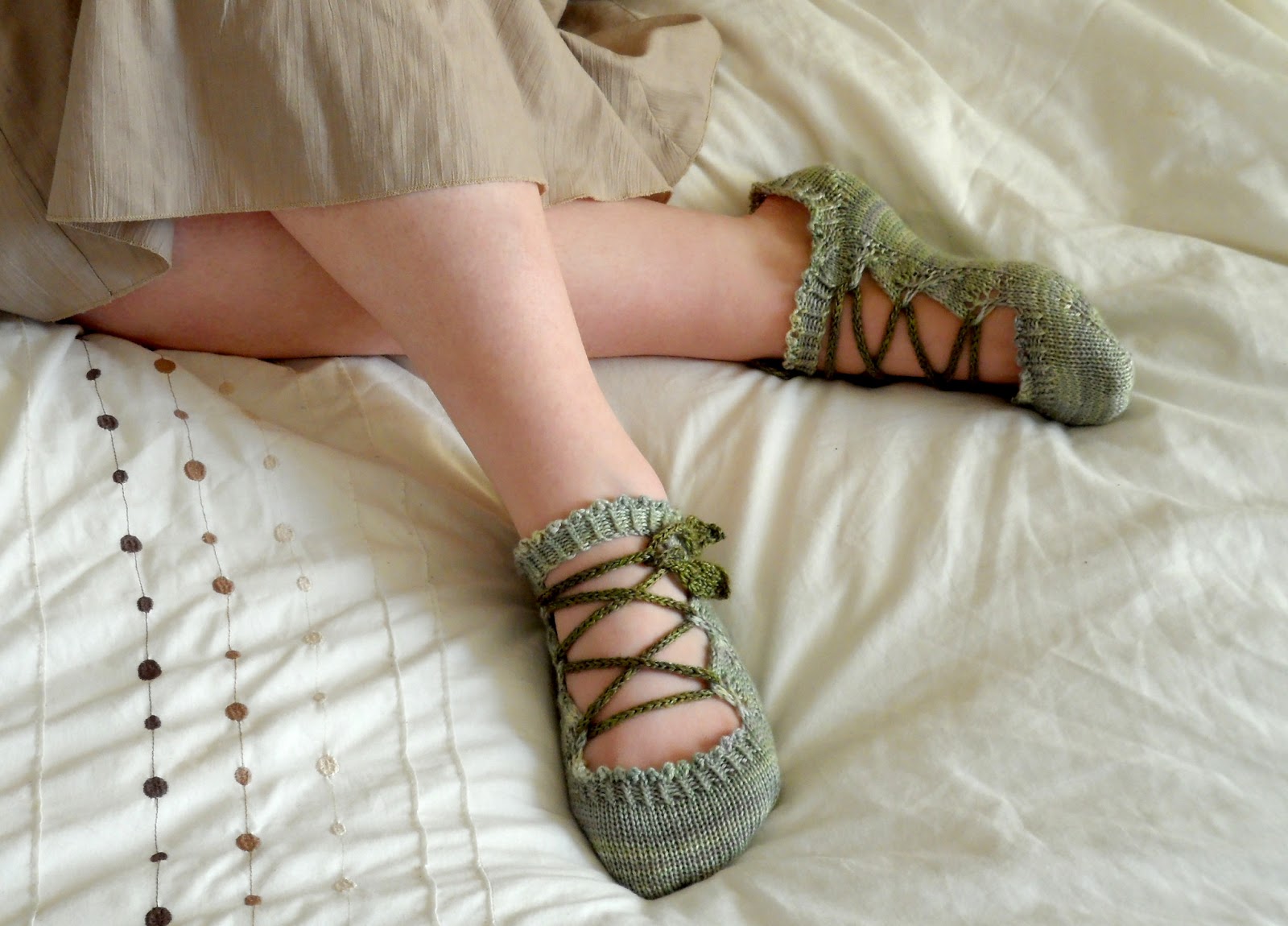
http://www.ravelry.com/patterns/library/elven-slippers


How do you feel about the so called controversy of "dumbing down" patterns for knitters?
Many of my designs skew intermediate/advanced because those are the things I like to knit. There's a place in the market for patterns of all levels, from the most basic items for beginners to the most intricate lace or colorwork.
That having been said, one thing I've had to learn is to not try to fit too much into a design. Elegant simplicity is superior to overcomplication. A design with too many elements will feel crowded and no one element will be able to stand out. Similarly, a pattern with too much extra information sometimes just isn't necessary. Sometimes adding extra tutorials and explanatory notes will strengthen a pattern and make it clearer - but sometimes it will just further confuse things, which is something I have struggled with. 

Do you use a tech editor?
Yes - for me, the hardest part of designing and pattern-writing is making sure my instructions are clear. I can come up with an idea, but that doesn't mean I can explain it well! For that reason, I find a tech editor to be invaluable.

How many sample/test knitters do you have working for you or do you do it all yourself?
I don't use sample knitters but I do try to get my patterns tested if time allows. I feel that tech editing and test knitting complement each other well - the tech editor will check all the numbers and make sure things are consistent and clear, and the testers can uncover other issues through the process of knitting. The way I see it, the more eyes looking over my pattern, the better the final result is going to be.

What impact has the Internet had on your business?
If it weren't for the Internet, I wouldn't be designing - heck, if it weren't for the Internet, I might not even be a knitter in the first place! The wealth of resources and community on the web are what fueled my fibre passion, right from the start. The web has also spawned a lot of great online magazines with high production standards and designer-friendly policies. There's a lot of competition these days but I'd say it's a good time to be a knitwear designer.


http://www.ravelry.com/patterns/library/garden-path-moebius

How do you maintain your life/work balance?
I have a day job, so it's more like a work/work balance. ;) I don't have as much time to spend on designing as I would like, now that I'm working full-time. I was fortunate enough to have a short period where I was able to work nearly full-time on my designing, which allowed me to build up my portfolio. Now I'm focusing on self-published work, which has the benefit of being much more flexible.

How do you deal with criticism?
I try to take everything as coming from a good place. Feedback from knitters is really important to me, because even after tech editing and test knitting, sometimes errors will slip through. Criticism comes in two forms: Something I can learn from, and something I can't. If I can learn from it, I will - I'll fix the error, or make the instructions clearer, or I'll know something for next time. If I can't learn from it, then it's best not to pay attention to it.

What advice would you give someone who wants to pursue a career in knitting?
Do things right from the start, to the best of your ability. There is such a wealth of information available now - on Ravelry, on blogs like this one, in classes and books - that a budding designer can read up on everything and really get off to a professional start. I did some things as a newbie designer that in hindsight I wouldn't have done.
We live and learn, and I've learned a lot and I'm sure I still have much more to learn. But I think with the increased competition it is more important than ever to produce a quality product in order to stand out from the crowd. If you can develop your photography and writing skills, get things properly tech edited, and promote yourself effectively right from the start, you're already ahead of a lot of other people.                 


http://www.ravelry.com/patterns/library/unbraiding-cables-hat

Wednesday, May 1, 2013

Grumpy Cat

http://brutal-knitting.tumblr.com/

I was delighted to see this photo on Knithacker. Knitted art by Tracy Widdess - available by commission and for exhibition. 

Grumpy cat has a fan following at my house. My husband loves the captioned photos that show up around the Internet of this cat whose owner claims is not at all grumpy. 

The images below all popped up on an internet search.


The photos with captions are the funniest. Merchandise is available here as well.


Monday, April 29, 2013

How Swatches Lie or We lie to Ourselves


I hear it all the time "swatches lie". Unfortunately I think the real problem is that we lie to ourselves. We are in a big hurry, we are excited and we have to start the project now. We forget how differently we all produce fabric. I show two swatches at the beginning of every class I teach to remind students of just how much our work varies from knitter to knitter. You can see them here. We all have differences in knitting technique, how we tension the yarn, and how we form our stitches.

Then we introduce different yarns to the equation. Many experienced knitters have commented to me how standards are changing. Yarns labelled as DK could be closer to worsted or sport weight. More ball bands give ranges of gauge instead of a single number as was more likely in the past.

The photos above show two different yarns that knit to the same gauge. One is 100% wool the other has some silk and cotton blended with the wool. The first photo is before blocking, the second shows both after blocking. Do you see how very different they are? Notice that they do block out to the same size.

Recently my tech editor was checking measurements on a shawl. I measured  the shawl immediately after blocking it and noted the details in the pattern. She remeasured about two weeks later after I had already worn the shawl. Guess what? The measurements are a little smaller now. This is not a problem for a shawl but it can be on a garment.

Swatching Tips

  • Use the same needles on the swatch as on the project. 
  • The needle material and type can affect gauge. I've read that in general, sticky needles like wood, bamboo or plastic will give you the shortest stitches, and slippery metal will give you stitches that appear a little more stretched out. This will impact your row gauge.
  • Swatch in the round for knitting in the round. Most knitters have gauge differences between knitting and purling. Knitting in the round may mean no purling, therefore different gauge.  
  • Let your swatch rest before measuring.
  • Hang it up if the yarn is a fibre that has drape like bamboo or silk.
  • Know that the same yarn in a different colour may knit to a different gauge.  
  • Check the gauge of different stitches in a single pattern. I work with two sample knitters who both have discovered they may match my gauge on one stitch pattern and not another. We have had to adjust stitch counts or needle sizes to correct this variation.  
  • Consider the fabric you are creating. Is it too stiff or too floppy? Will you like that in the finished project?
  • Launder the swatch according to the instructions on the ball band. Block it. You do want to know what will happen when you wash your project.

Friday, April 26, 2013

An Interview with Ann McCauley


Once a week I post interviews with interesting designers about their insights on their experience of working in the Knitting industry. I’ve noticed that every designer makes their living in a slightly different manner bringing their own unique presence to the Knitting world.

You can find Ann here and here on Ravelry.

http://www.ravelry.com/patterns/sources/the-pleasures-of-knitting-timeless-feminine-sweaters


Where do you find inspiration?
Creativity is among the very most interesting things in life to me.  I feel inspiration is pretty much everywhere, when we’re open to experiencing it.  Consistent sources for me include, but are not limited to – yarn, color, texture or stitch patterns with their endless possibilities of combinations; line and shape; or becoming very quiet and still, going within – any of these elements can be the inspiration point. I believe the creative process can be highly variable. At times, I have had that flash when I may see every detail of a new design.  And I’ve also experienced painstakingly swatching to the length of a scarf, but it’s a jumble of stitches without finished order that I have to see and allow to inform me. I greatly enjoy watching a design evolve. Often that initial inspiration or direction is followed by research or experimentation. It’s a very visual process that leads to the very technical process of writing and sizing the pattern.

What is your favorite knitting technique?
My niche as a knitter is primarily women’s sweaters worked in smooth yarn, solid color and texture with an occasional skirt, dress or tunic thrown in.  I love the invisible seaming from the right side of a garment.  Seams give definition, structural integrity, body and fit to a garment.  I know of no reason to avoid them.  Look at the fine dress makers. Look at couture clothing.

How did you determine your size range?
Usually, it is 4 – 7 sizes, determined by where a design is published.

Do you look at other designers' work or are you afraid that you will be influenced by their designs?
I look at fashion magazines to be aware of trends.  I look at designs online only as time permits.

How do you feel about the so called controversy of "dumbing down" patterns for knitters?
I think we’re in the information age.  I think online publishing of patterns allows for more explanation than print does.  If a pattern gives more information than a knitter needs, an experienced knitter will jump past information they already know.  If a pattern gives information that a less experienced knitter needs, chances are they are going to learn something and have a better experience and result.  Let’s face it, knitting patterns have been written in some cryptic or general styles in past eras.  I have some knitting publications from each decade back to the 1900’s and it’s hard to believe how recently patterns were published without schematics.  I like being able to include information in a pattern that helps to ensure a better result and if that means explaining a blocking detail that enhances the finished garment, for example, then that’s something I want those making it to know. 

How many sample/test knitters do you have working for you or do you do it all yourself?
I do it all myself.  It’s one of my favorite parts and I love process.  I feel I can make better decisions as a designer if I knit a piece myself.  Possibilities occur that I may not have been able to see otherwise.

Did you do a formal business plan?
Honestly, no.  Although I do ask myself quite frequently, what’s next?  It was a surprise to me to become a knitting author.  I had been designing the sweaters that I wanted to wear.  I have no formal training in this field, I had never written a book, and I submitted to one publisher.  I studied knitting books and magazines.  I had an internal sense that I would write a book one day, but did not know what type of book.

Do you have a mentor?
I feel that Barbara Walker is my mentor in the knitting world.  Without her stitch collections, I don’t know that I would have started to design sweaters.  I love her respect of history and use of original names of stitch patterns.  It is unusual for me to have a mentor I have never met, spent time with, studied with, etc.

http://www.ravelry.com/patterns/library/classic-cable-and-corded-rib-turtleneck

Do you have a business model that you have emulated?
No again, one thing has led to another and I have followed what it’s led to.  For example, Martingale & Company sent my first book, The Pleasures of Knitting: Timeless Feminine Sweaters, to Knitty Gritty and that led to me filming Delightful Details for them.  After doing a second book, Together or Separate: Knitting the New Twinset, with Martingale, I realized that I needed to focus on single designs for awhile.  Two years ago, I met Jared Flood when we were both teaching at Yarnover in the Minneapolis/St. Paul area which led to having designs in his Wool People Collections.

What impact has the Internet had on your business?
I think the Internet is changing the knitting world daily in ways we are still discovering.  Look how quickly Craftsy has altered the accessibility of knitting classes.  It’s been a huge door opener for independents in the field.

Do you use a tech editor?
Oh yes!  There are a very few exceptions when something is of an extremely simple nature.

How do you maintain your life/work balance?
Eat well, sleep well, listen to the body, exercise, remembering to live in the present.

How do you deal with criticism?
Listen, reflect, respond.  Ask questions.

How long did it take for you to be able to support yourself?
I like variety in my work life so knitting is not my sole support.  I enjoy a blend of working at home and away from home. 

What advice would you give someone who wants to pursue a career in knitting?
It’s the same advice I would give to someone in any career – do what you love.


Wednesday, April 24, 2013

One Year Ago......

I occasionally go back and read my own posts. It's interesting to see what I was thinking and writing about in the past. Sometimes I've learned new things that I want to write about now or my perspective on a topic has changed. 

Last April I wrote this post on the concept of time and how it can be different for knitters. Later I read two fascinating books on the concept of time. The first was The Time Paradox. It is about the psychology of time, how it effects individuals and cultures. The second was 168 Hours, about how to get the most out of the time available to us.

I also wrote about knitters and how they choose a project here. In that post I was looking at challenge vs. practicality. The following month I wrote about how challenge and learning has maintained my interest in knitting more than any other artistic pursuit.

I discussed concepts of good fit here. I teach these concepts in several of my classes on garments, fitting and pattern drafting.


Monday, April 22, 2013

The Knitted Boyfriend


Buzzfeed has a quirky little video created by artist Noortje je de Keijzer posted. You can find it here. My husband showed me the video before I read the article and the first thing I noticed was that "the Girl's" knitting style looked very awkward. It turns out that the artist's mother and grandmother knitted the initial prototype. The final version was created by knitwear designer Sarena Huizinga  on an industrial knitting machine. The video maker is quoted as explaining this was "Partly because of practical reasons, and partly because I found it an exciting idea that a knitted man could just come out of a machine in one piece in a very short time, as if he was being born!"

I posted here on the same topic some time ago when I first realized that in installation artwork the knitting is frequently not created by the artist. So link on over, see the video and let me know what you think.