Friday, August 13, 2010

An Interview with...Carol Feller


Once a week I post interviews with interesting designers about their insights on their experience of working in the Knitting industry. I’ve noticed that every designer makes their living in a slightly different manner bringing their own unique presence to the Knitting world.

You can find Carol here and here on Ravelry


Where do you find inspiration?

Inspiration comes from lots of different places. Often design ideas start popping up when you begin swatching. Working with a new yarn and a variety of stitch patterns your imagination begins working. Other times ideas come from my own needs, I can see a finished piece in my head and I just have to have it!

What is your favourite knitting technique?

I love seamless, shaped knitting. Almost all of my sweater designs are knit in one piece from either the top down or bottom up (and occasionally from side to side!). Shaping is very important to me as it changes your finished knit from blocks to a beautiful flattering piece.

How did you determine your size range?

I would like my patterns to be available to as wide a range as possible so I attempt to size them from 30-56 inches. I’ve also been playing around a little with the sizing increments. 4” between sizes is far too much but if you reduce it to 2” you end up with an unwieldy volume of numbers that makes it harder for knitters to follow. I’ve settled in between (for now!) with 3” increments.


Do you look at other designers’ work or are you afraid that you will be influenced by their designs?

I love to look at what other designers have produced. I greatly appreciate designs that are elegant and unique. We are all influenced by what is around us and we would just be fooling ourselves to think otherwise. You draw on all this inspiration when you create your own designs and produce something uniquely you that comes from within yourself. We do need inspiration though, colors you use follow current trends and different styles go in and out of fashion.

How do you feel about the so called controversy of “dumbing down” patterns for knitters?

I think a lot of knitters over the last few years have either returned after a long break or are beginning for the first time. This means that patterns need clear directions with unusual techniques fully described. I don’t feel this is a dumbing down of patterns, just well explained directions so that a knitter can be as sure as possible to be in control of the small details that make all the difference in the finish of their knitting. I know how frustrating it is when you do not have extensive experience not to be told decreases/increases to be used (for example) when working on a garment. You know what you have produced looks different to the sample but you don’t know why. They should be given the full instructions!

How many sample/test knitters do you have working for you or do you do it all yourself?

I knit all first samples myself. That way I can ensure that all details are correct and if I know something doesn’t (or won’t) work I can change it. Just because you can see a finished product in your head doesn’t always mean that the knitting wants to end up exactly that way. Often details have to be pared down so the key feature in the design will be the focus. I write the bones of the pattern before the knitting so I consider myself the first test knitter. I do have a couple of wonderful knitters (two primarily) who do a second sample for me if I feel it is necessary. Occasionally it may be because I don’t get the sample back other times I know the design would really photograph better in a different yarn or I’ve made a major redesign.

I have attempted to do extensive test knitting of all sizes before and I never felt I got huge benefit from it. It is unfair to expect knitters to just knit for the free pattern with the result that often only 1-2 knitters will end up finishing. It also delays publication considerable. I find that almost all faults found by test knitters were corrected by tech editors anyway.

Did you do a formal business plan?

I don’t have a formal business plan but I do review my goals and the direction I’m going on a regular basis. So an in-formal business plan!

I previously ran an online business that I just loved growing. However I didn’t have much direction which meant that even though I had a considerable cash flow there was little to nothing going into my pocket. It also made me realise that I love growing a business but just managing and keeping something ticking over holds no appeal for me. This past experience has made me very careful to look at how I move and that I’m going where I want to.

Do you have a mentor?

No, but I do have a lot of ears that give me feedback when I need it!

Do you have a business model that you have emulated?

Not directly. However due to having run an online business before I knew what I didn’t want! My previous business was retail and growing the business involved more hours and money invested. Although you have less control of what designs are popular you do control more directly the hours you put in and increased popularity doesn’t involve considerably more work as pdfs are delivered automatically. Obviously more sales can involve more customer service but I am finding as the pattern instructions become more extensive this has not increased exponentially.

What impact has the Internet had on your business?

My business did not exist before the internet and I don’t think it would exist without it. Online pdf sales allow me direct contact with my customer with minimal upfront costs and risks. This makes it easy to try new things, if they work great, if not I can chalk it up to experience.

I do some printing and sales directly to shops but this is a much smaller part of my business.

Do you use a Tech Editor?

Yes, I wouldn’t dream of releasing a pattern without my tech editor.

How do you maintain your life/work balance?

I have 4 small children so working from home is both a curse and a blessing. During the school term it is relatively simple. In the morning I do computer work (internet and designing), afternoons is for the kids and my knitting time is in the evening when they are gone to bed. TV is a great knitting companion, I do however find it hard to ever devote time to reading as it doesn’t combine with knitting all that well. I think I’m going to have to try audio books.

Summer holidays are a lot harder. I still try to work in the office in the morning but obviously there are a lot more interruptions. I’m trying to reduce the amount I do over the summer to make it a little easier.

How do you deal with criticism?

While criticism is never easy it is very necessary. I have no interest in dealing with customers who are just being negative for its own sake but I love when any errata are pointed out or when difficult to follow directions are mentioned. It helps you grow as a designer and keeps you focused on ways of making your patterns as clear as possible.

How long did it take for you to be able to support yourself?

I never expected to make a full time income from designing as I don’t have full time hours available to me due to the children. However I am now earning enough from designing (although it is of course rather erratic!) that I consider it a very fair payment for the hours I invest each week. It took me around 2-3 years to reach this point.

What advice would you give someone who wants to pursue a career in knitting?

Be honest with yourself and what you want out of it. If you expect a full time income with no risk it isn’t for you! However if you have secondary income (yourself or significant other) and it makes you happy I’d say go for it. I was originally an engineer and when my youngest was small I attempted to get back to college to work on a PhD. I was so miserable when I wasn’t knitting though that I felt as though I didn’t really have a choice. I finished up my tutoring and threw myself into knitting.

Even though I didn’t have a very formal business plan I had a good idea of the direction I wanted to go in. When you work for yourself you need to be constantly pushing forward and marketing. Nothing comes to you; you have to get yourself out there...in publications, online in chat forums, blogs, etc. Constant evaluation is also necessary, if something isn’t working after a good shot – stop. Just because it works for someone else doesn’t mean it will for you. I’m a big believer in the ‘suck it and see’ philosophy; I do need help though in not just persevering for the sake of finishing something even when it obviously isn’t working.



Wednesday, August 11, 2010

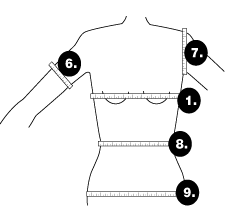
Designer Secrets - The Chest vs. the Bust measurement


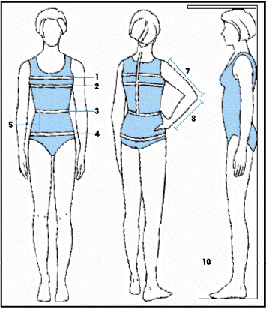
The chart on the right comes from here The one on the left is from here It's the CYCA chart that many Knitting designers use as a standard when grading all patterns. The one on the right shows a chest measurement at 1 and a bust measurement at 2. CYCA shows only a bust measurement.

I rarely knit from patterns. On the odd occasion I do it's usually because the design has a feature or technique I'm really interested in trying. The last pattern I knit was this
one It's beautiful!


As you can see with this design the pattern size choice based on a bust measurement makes sense but it doesn't for every pattern. In particular those with set in sleeves. I've been custom designing for my own unique measurements for so long that I'd forgotten how difficult it can be for Knitters to choose the correct size when using patterns. When I was taking sewing classes I was taught to take both bust and chest measurements to aid in choosing the correct pattern size especially if you were over a B cup. The thinking was that while bust measurements gave you the width required the chest measurement was more closely based on bone structure size. Normally it is easier to make the bust bigger than it is to change the shoulder, armhole and sleeve cap relationship. If I use the CYCA standards I drop a size by using the chest measurement. My back waist length isn't even on the chart because I'm 5'2". If I look at my upper arm measurement I go up a size? I sound like I must be some sort of a science fiction mutant don't I? Well I'm not... I'm pretty average. So what I'm getting at here is that it doesn't really matter what standard measurements a designer starts from because the reality is that almost every knitter will need to make some adjustments to fit their pattern to their body. You will always need to compare your measurements to the patterns and adjust accordingly. So try taking a chest measurement especially if your sweaters don't fit at the shoulders and neck and see if that changes the size you would change on the pattern. See this previous posting for an adjustment idea if you need more space in the bust area only and this one here for making your sweater fronts bigger.

Monday, August 9, 2010

As promised ...a few more balcony pictures

This is George out on the balcony. He is normally camera shy but when he gets outside he is so distracted by the great outdoors that he doesn't notice the camera flashes.


This is the narrow end of the balcony. I fill it with lots of plants and this is my view from the loungers at the wide end.


I'm on vacation so I won't be able to publish comments until my return. I've scheduled postings as normal though so please continue to visit me.

Friday, August 6, 2010

An Interview with... Mercedes Tarasovich-Clark

Add Image


Once a week I post interviews with interesting designers about their insights on their experience of working in the Knitting industry. I’ve noticed that every designer makes their living in a slightly different manner bringing their own unique presence to the Knitting world.
You can find Mercedes here and here.


-->
It’s probably been said many times before, but *everywhere*. But when I’m really jonesing for some fresh material, I check out fashion magazines and websites, I cruise Flickr for interesting photos, or I just head to the mall (a rare occurrence!) to see what’s on the mannequins. I keep my iPhone camera and sketchbook handy, because you never know when a great idea will sneak up on you!

What is your favourite knitting technique? I usually tend toward textures like cables and lace, but my current obsession is two-color brioche rib. Ever since reading Nancy Marchant’s Knitting Brioche, I’ve gone down the rabbit hole with this technique and just keep coming up with new projects to play with it. The possibilities for color and texture, and combining to two, just blow my mind.

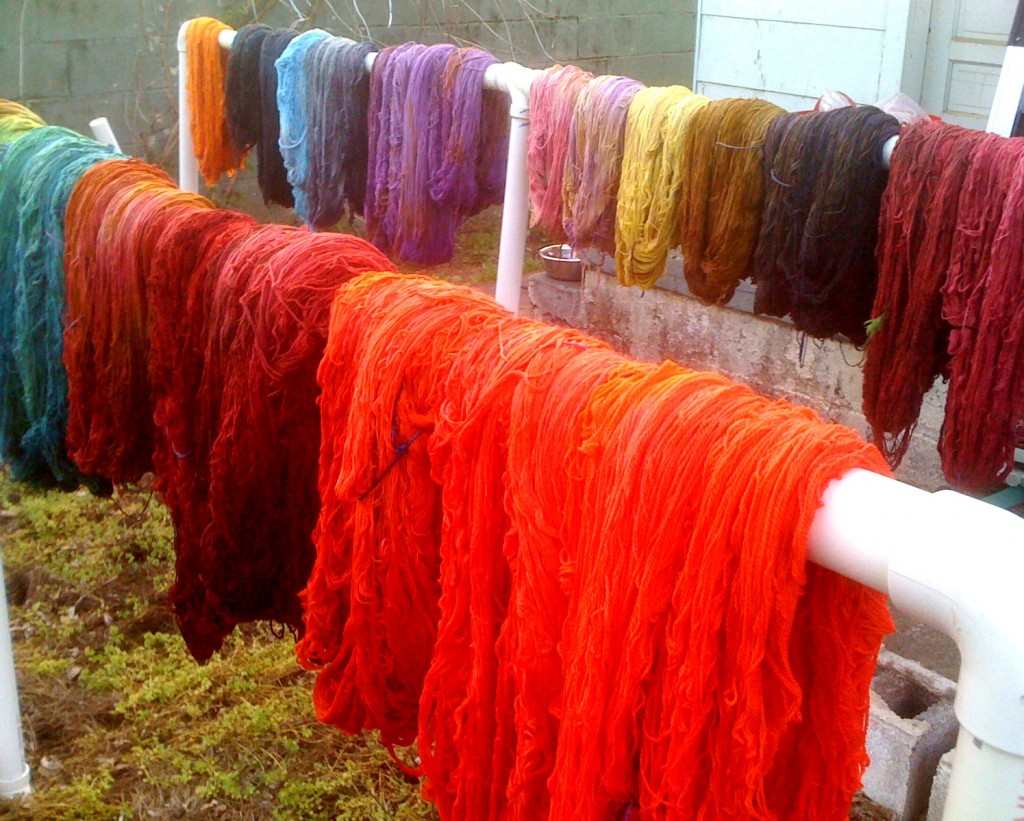
What is your favourite dyeing technique? I love dyeing subtle multi-colors and semi-solids, both of which I make using a handpainting/pouring technique. Since I use so much texture in my knitting, the really wild multi-colors have had less of a place in my work, and the subtler color changes really work well with cables and lace.
How do you choose the fibers that you work with?
From a knitter’s standpoint, I try to use fibers and textures that I really LOVE to work with. Some are hardier, some more delicate, but they all have a place in my stash. From a businesswoman’s standpoint, I try to tailor the line down to materials that are reliable quality and that I can stock relatively consistently.

Do you look at other designers' and dyers work or are you afraid that you will be influenced by their choices? I really can’t NOT look at other’s work unless I want to live in a bubble, so yes, I always try to have a clue what’s going on in my industry. But I do take that info and try to use it wisely, so that I can follow a trend without stepping on the toes of a colleague (who many times is a friend, too). If you have a clear sense of your own design style and color palette, you can be inspired and influenced by other designers and dyers without it all becoming homogenous.
How do you come up with names for your yarn?
A while back, I used to try to come up with super-clever, witty names for all of my colorways, which was fun when I only had about a dozen or so. But then, because I love color so much and was crazy about too many options to narrow it down, my offerings expanded to 50+ colorways. That’s when I decided to name them after people, both real and imagined. My husband always boggles at the fact that I can remember them by sight, and I always reply, “I recognize them because they’re mine!”
How do you feel about the so called controversy of "dumbing down" patterns for knitters? I’m not so sure it’s a real controversy; there will always be a place for simple patterns, both for new knitters as well as seasoned knitters that want something quick and easy. I started in this business with a brick-and-mortar yarn store at the height of the glam/fluff/glitter scarf craze 6 years ago, and watched many of my customers and students grow into very experienced knitters working with complex lace patterns, Celtic-style cables, Fair Isle, and the like. I think there’s a place for both, always.
How many sample/test knitters do you have working for you or do you do it all yourself?
Currently, I do it all myself, but I think in the near future, I’ll need to find a few reliable knitters to keep up with my ever-increasing project load. I tend to work out the details of the project on the needles, so a lot of my designing is hands-on.

How do you maintain your life/work balance?
To be perfectly frank, I often don’t. It’s something I’m working really hard on establishing, especially keeping my weekends as work-free as possible. But in reality, the flexibility of being able to take personal time in the middle of a M-F workweek often has to balanced out by a rush of work on a Sunday afternoon. But I have an understanding, sometimes-freelancer, husband, and no kids, so I can handle a little bit of crazy. Before someone jumps into this life and schedule, they should take a look at what their family and household can handle as far as weird hours and unpredictability. (side note- I’m writing this from my favorite café at noon, drinking a beer. A plus in my book, but not everyone can actually produce consistent work in this environment.)

How do you deal with criticism? I’ve embraced the concept of “right people”. As in, not everyone will get my work, not everyone will get me, but when I find the ones that do, that really LOVE what I’m doing and who I am, those are the people I focus my energies toward. I don’t have the brainpower and energy to spare on “converting” critics. Not everyone will love what I’m doing, and that’s ok; the ones that do make it all worthwhile and so incredibly satisfying.
What advice would you give someone who wants to pursue a career in knitting or dyeing? #1, without a doubt: BE YOURSELF. Figure out what your vision is, who you want to reach, what you want to create, and do it.
Also, take the time to market. If you have an awesome product, you need to let people know, make it easy to find, tell them what it is, how to get it. Take to time to get out into the community, both real world and internet, and interact. And I don’t mean just shilling your stuff, but really make connections, and interact with others in your field. Those connections will not only provide moral support, but lead to word of mouth advertising. Go. Do.

Wednesday, August 4, 2010

Garment Designer - The Workshop

I took a class recently with Carolyn Barnett on Garment Designer. I bought this software some time ago and have been teaching myself how to use it. I seem to be doing pretty well but taking a class and hearing the questions of other students always accelerates one's learning curve. Carolyn is a machine knitter so the class was geared to that but it is still totally appropriate to hand Knitters as well. I do own several knitting machines but at the moment I'll totally focused on hand knitting.


I always enjoy being a student especially with a great instructor like Carolyn. The workshop was held in a friends dining room. We really enjoyed the wonderful treats and lunch provided by our hostess Sonja.


We all measured one another so that we were able to develop custom slopers for ourselves. Mine is a little odd in appearance but the advantage of the program is that it always keeps the sleeve cap and armhole in proportion. You can also input different front and back measurements which is something I have been doing with anything I knit for myself. I wrote about that in a blog posting some time ago
here. My other fitting issue is that my upper arm is larger than average. I wasn't happy with the armhole that the software creates for me but Carolyn was able to show me exactly what I need to do to adjust the armhole and still maintain good fit. She has been doing custom fitting for years with her private clients and that knowledge really helped as we all asking our questions about specific fitting issues.


If you are interested in the software you can find more about it
here

Monday, August 2, 2010

My Knitting History


My sister Holly and I recently went through many of the old family photo albums that were stored in bins in her storage locker. Neither of us have children so there is no one to pass these albums to. Many of the photos are so old they are beginning to deteriorate. We each picked out a selection of shots that we wish to keep for ourselves and will restore. I pulled out a group of ones that show me wearing hand knits (and one crocheted poncho) that were all done for me by my Mother and decided to share them with you. Judging by my various hairdos I was any where from 12 to 18 in these photographs. I started knitting for myself when I was 17 but I do remember the fun my Mother had making these garments for me. She was a prolific knitter and gave many many items away as gifts and as donations to needy causes. She was always happy to knit for me and we enjoyed picking the patterns and colours out together. I will always have very fond memories of her and those times. She passed away from Ovarian cancer when I was in my early twenties. I like to think about how her love of knitting has been passed to me and lives on and of all the wonderful friends and things that have come into my life by maintaining her legacy and honouring her memory.