Wednesday, May 7, 2014

You're Doing It Wrong!


"You're Doing It Wrong!"

Arrggggg! For some reason I've heard one knitter say this to another knitter at least five times in the last month. I'm becoming very irked by this comment. So far I've managed to bite my tongue and stay out of these discussions, unless someone asks for my opinion.

Why does this bother me?

Well it bothers me because there are so many different techniques, traditions, approaches, new un-inventions and cultural things happening in the knitting world that to label anything as wrong is just misguided. (I wanted to say wrong there but I had to avoid that phrase for obvious reasons didn't I?)

I want to tell knitters to try everything out and decide for yourself. Using different techniques can give you different results or equal results or better results. Experts don’t always agree on which techniques are best but it’s clear that there are benefits to each one. 

A student recently told me she thought it was very funny when one of my other teaching friends gasped in horror about something I teach in my classes. My friend is an excellent knitter and teacher but she falls into the school of "one best way" while I am most definitely not in agreement with that approach. I can see merit in it however, especially for novice knitters as it is less confusing for them. 

For my other hated phrase, you can read my post on Row Gauge doesn't Matter here.

If you enjoy reading my blog, I'd really appreciate it if you would tell your knitting friends or share links to your favourite posts online with Twitter, Ravelry or Facebook. Word of mouth is really helping to grow my business as knitters respect the views of other members of our community. Thanks!


Monday, May 5, 2014

How to Remember the Difference between M1L and M1R Increases

 
M1L/M1R on the left side  M1R/M1L on the right side outlined my markers (Click on the photo for a larger view)

In every glove class I teach we always have some discussion regarding the positioning of MIL and MIR increases on either side of the thumb gusset. The six hour version of the class has students working on a mini sample to test as many glove making skills as possible. We work the glove in stocking stitch using a M1R increase on the left and M1L on the right of the thumb gusset. I've looked at a lot of glove patterns to check what increase is recommended. Many patterns avoid the issue of which increase to use by giving the instruction as increase 1 or M1 with no specifics as to the intended increase. Pattern standards are shifting and many tech editors recommend that designers be more specific with these details. I see M1L and M1R (worked in that order) fairly frequently and on occasion I see them in reverse order. I have had the best results with the order in the right half of the photo above (M1L then M1R on either side of a central stitch). It is a tiny bit bit smoother for me. If you look at the left side of the photo, one leg of the stitches is slightly out of alignment. In some stitch patterns this might look better. The best increase to use in a specific situation is always going to be dependent on a number of factors, including the yarn and needles being used, the stitch patterns used and the knitters individual knitting style.


In the case of M1L and M1R, the increases do have directionality but it is not as prominent as the slant that we see on the paired decreases k2tog and ssk. 

M1R on the left side M1L on the right side (Click on the photo for a larger view)
The photo above was taken just before the needle drops out of the new stitch being created. M1L is still sitting on the left needle and slants to the left. The M1R is on the right needle and slants to the right.


M1R on the left side M1L on the right side, the new stitch is worked just above the marker. (Click on the photo for a larger view)

The trick I use to remember each one is:

M1L is worked by using the left needle, to lift the running thread between stitch just worked and next stitch, from front to back, and knit into back of resulting loop. (FBB). 
 
M1R is worked by using the left needle, to lift running thread between stitch just worked and next stitch, from back to front, and knit into front of resulting loop. (BFF). I keep them straight in my mind by adding the phrase "my best friend forever is always right"


There was a recent thread on this topic on Ravelry here. It's an interesting discussion because the posters look at what happens when you are working on the right and wrong side of the work. They question, is the R and L of the name referring to the direction of the lean or the placement of the new stitch in relation to a central stitch as well as looking at the order of execution of each increase.


The best way for you to understand the nuances of this discussion, is to knit a sample and watch carefully as you work each variation, then decide what works best for you and for your specific project. If you read the thread, note that different knitters get better or more pleasing results in different ways. 

You can see my Glove series of posts here.


Sunday, May 4, 2014

The winner is.....


Lori


You won! Your blogger profile does not have contact info. Please email me your email address. My contact info is at the top of the page.

Nancy has asked me to provide her with another winner if we don't hear back from you by Tuesday April 6th at 9 AM

Thanks
Robin


Friday, May 2, 2014

An Interview with...Julie Turjoman


http://www.ravelry.com/patterns/sources/knits-that-breathe-12-breezy-projects-to-keep-you-cool/patterns
Once a week I post interviews with interesting people about their insights on their experience of working in the Knitting industry.  I’ve noticed that every one of these individuals makes their living in a slightly different manner bringing their own unique presence to the Knitting world.

You can find Julie here and here on Ravelry. 

All photos included are copyright  Zoë Lonergan

Where do you find inspiration?

I often look to the fashion industry for knitting inspiration, and find it a pleasurable challenge to create designs that had their origins in sewn garments, but that lend themselves to knitted interpretation. When that knitted interpretation is successful, it's as attractive as the original but with the wonderful texture and shaping elements that can be created only by knitting. In addition, with a 20-year career as an interior designer behind me, my eye is constantly drawn to surprising color combinations and textures, unusual proportions, and unexpected but effective asymmetry or balance in design. Finally, I often look to fashion history for inspiration. Vintage elements often appear in my designs, particularly the accessories. From my perspective, some of my most enjoyable published designs were those that appeared in Interweave's Jane Austen Knits.


What is your favourite knitting technique?


It's impossible to choose just one. I love lace, and the ways it can be added strategically to garments for that extra little fillip of visual excitement, movement, or texture. As a left-handed knitter who knits right-handed, I adore color work but find that Fair Isle slows me down unbearably. To combat that, I do a lot of slip-stitch color work and have come to enjoy and appreciate its versatility and attractiveness. Short-Row shaping is another technique I've embraced because it allows for such wonderful drape, customizable fit,  and motion in garment design.


How did you determine your size range?


I strive to be inclusive, so over the years I've expanded the size range of my garment designs. It's important to me that knitters with a wide range of body types and sizes look good and feel good in them. My patterns generally go from a 32" to at least a 54" bust circumference, and often up to a 60" bust. In my new book, Knits That Breathe: 12 Breezy Projects To Keep You Cool, more than half of the patterns are sized up to at least a 54" bust. That said, knitters need to look critically at any pattern and decide for themselves whether or not it will flatter them. It's not the designer's responsibility - nor is it possible - to customize fit to such an extent that every knitter would be able to wear it. Just as I, at barely 5 feet tall, often need to shorten sleeves in a pattern, or raise the waist, or make the body shorter, in order for it to fit and flatter my figure, every knitter should be prepared to make and execute those choices for herself or himself.  
Do you look at other designers' work or are you afraid that you will be influenced by their designs?

I love to see what other designers are up to! It's common for me to admire details of their designs without being influenced by them in my own work. If anything, they inspire me to up my game and be a better designer.

Could you tell us a little about your recent book Knits that Breathe?


My relocation from the Bay area to Chicago a couple of years ago re-introduced me to sticky, hot, and humid summers with no cooling relief at night... and I sadly put away my "lightweight" wool summer sweaters that had gotten steady wear in California. Then when menopause struck, it struck hard; I often had as many as 20 hot flashes a day. It was woefully clear that I couldn't wear my wool, alpaca, and cashmere sweaters for the duration. In a page straight out of the "necessity is the mother of invention" playbook, I was determined to find yarns with cooling rather than heat-retaining properties. 

Knits That Breathe is the culmination of a year I spent experimenting with alternative fibers such as Tencel, SeaCell, milk, and soy, as well as fibers derived from various plants such as bamboo, cotton, and linen. All the fiber blends in the book are known for their cooling, moisture-wicking, draping, and fast-drying properties... just what I needed. And I quickly realized that if garments made from these yarns meant that I could wear my hand knits again, then there must be thousands of other knitters who would also appreciate the results of my research. In addition to knitters who live in warm climates, and knitters who either run hot all the time or are going through menopause, I factored in knitters who are sensitive to wool and find it itchy. So Knits That Breathe is for them, too!

The projects are stylish and comfortable, and designed to flatter a wide range of figures. Many include lace panels that provide their own air-conditioning. All the yarns used for the designs were widely available as the book went to press.
 
http://www.ravelry.com/patterns/sources/knits-that-breathe-12-breezy-projects-to-keep-you-cool/patterns


How do you feel about the so called controversy of "dumbing down" patterns for knitters?


A short question that deserves a rather long answer! When I learned to knit 25 years ago (before the Internet), I had to make a trip to my LYS when I needed help with a project. Patterns were not written as clearly then, sizing options were limited, and directions often assumed broader knowledge on the part of the knitter. Nonetheless, even a beginning knitter was expected to be self-reliant, and I quickly learned that if I made a mistake I could simply rip it out and start over, experimenting until I got it right. I bought a couple of thorough how-to books and researched my questions to determine whether I really needed to consult the experts at my LYS. Except for the long-tail cast-on method and basic knit and purl stitches, I am self-taught.

Many knitters today, with the wealth of information, photos, and tutorials available to them, are challenging themselves to create complex and beautiful projects as never before. While I make a tremendous effort to ensure that my patterns are clear and detailed, I also hope that knitters will seek out any additional assistance they need to achieve the successful completion of a project. That means using all the resources available to them, from the Internet to the LYS to their own knitting group. It's frustrating when a self-proclaimed "beginner" knitter emails me with request like this one: "I've never worked from a chart before, but I want to make your pattern 'XYZ.' Please tell me how to use charts so I can make this project." 

I never want to discourage a knitter from making one of my designs, and I don't believe in "dumbing down" patterns because that often results in less interesting end products. I do believe in providing the tools a knitter needs to work one of my patterns with success, such as including stitch patterns in written row-by-row as well as charted formats. However, my confidence in both knitters and in my detailed directions implies that knitters won't be lazy about using all available resources for information.  To that end, I'm slowly developing a series of tutorials to post on my website. These will provide tips and extra details about the techniques I use in my books and patterns, so that I can contribute to the existing knowledge base. My pact with knitters is that they'll be proactive and take advantage of that knowledge base to advance their skill set. 


How many sample/test knitters do you have working for you or do you do it all yourself?

At first, I couldn't afford to use sample knitters, but would provide yarn to knitters who were willing to work up a sample for me. Their insights about the pattern were extremely helpful - I could understand the value of having patterns test knit, but it was a long time before I had the resources to pay a sample knitter more than once in a while. I now work with a couple of sample and test knitters when a pattern draft is ready for its trial run. I still do the initial swatching to be absolutely sure I'm satisfied with the yarn's performance for a given project, and often work up parts of samples to make sure the concepts I want to include will result in the desired look. 
http://www.ravelry.com/patterns/sources/knits-that-breathe-12-breezy-projects-to-keep-you-cool/patterns

Do you have a mentor?

I'm very fortunate to be a member of the Visionary Authors group founded by Cat Bordhi. As one of these self-publishing designers, I have several informal mentors and act as a mentor myself to others embarking on self-published projects.
What impact has the Internet had on your business?

My first book, Brave New Knits: 26 Projects and Personalities From the Knitting Blogosphere, would never have been written or published if not for the Internet. I joined Ravelry early in its existence and spend time on it almost every day because it helps me stay in touch with the knitters' community world-wide. When I have a question about technique or resources, I go to the Internet first. It's such an integral part of my knitting life that it's hard to remember how I managed without it.

Do you use a tech editor?

Absolutely! The more sets of eyes on a pattern before it goes live, the better! Having spent many hours working up a pattern draft before it ever goes to my tech editor, I'm often too close to it to catch stylistic inconsistencies or minor grading errors, so my tech editor is a valuable part of my team. Designers have a responsibility to the knitters who make their projects, to ensure that their patterns are clear, mathematically correct, and sufficiently detailed, and my tech editor helps make that happen.
http://www.ravelry.com/patterns/sources/knits-that-breathe-12-breezy-projects-to-keep-you-cool/patterns

How do you maintain your life/work balance?

With one grown child who no longer lives at home and an understanding husband who also works hard, I'm lucky to have the time and flexibility to put in as many hours as I need. As a morning person, I do most of my pattern writing and editing early in the day. Much of what I do doesn't feel like work even though it is; knitting on long car trips, swatching in front of the TV at night, surfing Ravelry on my phone while waiting on lines, etc. I love to cook, so my husband and I have dinner together at home most nights - no phones on the table, no TV on in the background; just conversation and catching up. It's a ritual that helps me to turn off the work part of my brain at the end of the day. I also schedule time to see friends and family - that balance is important, but it requires conscious effort on my part.


How do you deal with criticism?


I live by the rule that you can't please everyone, so criticism generally doesn't bother me.  That said, when a critique has merit, I'll quickly publish errata and corrections; reliability is an important characteristic of any good designer.

How long did it take for you to be able to support yourself?


Self-publishing is a huge undertaking in terms of time and resources that can take many months, or years, to reach real solvency. While I contribute meaningfully to household expenses, it will be at least another year before I'd consider myself self-supporting.

What advice would you give someone who wants to pursue a career in knitting?

A career in knitting is not for the faint of heart, and requires energy, inspiration, and ingenuity in spades. Even a designer who seems to have sprung up overnight into celebrity status probably spent a year or more laying the groundwork for his or her success. Having a head for business is as important as having the creative spark because if you don't know how to budget and market yourself, that business goal will likely remain a fantasy. 

There's so much competition in the hand knitting design arena that the bar is set high - making it even more essential to be an active part of the community by posting your projects on Ravelry, by creating your own website, and by having your designs published in some of the many knitting publications both online and in print to get your name in front of other knitters. If you love to teach others and have mastered specific techniques for which there is a large audience, approach your LYS with an offer to teach a class. Go online and learn the submission requirements of knitting industry publications. Work up half a dozen patterns and samples to submit, and remember that good photographs will help you sell them!

Wednesday, April 30, 2014

Should you Take a Private Knitting Class? Part 2

Recently I did a one on one private session with someone who took a workshop with me a few years ago.

My partner on the road to knitting perfection told me she came to me for two reasons. The first was she likes the way my garments fit me. The second reason, she had noticed while we are very different sizes our proportions share some similar features. I'm short, she's tall, I'm busty so is she, I don't have a defined waistline neither does she. However I have short arms and she has average arms, she also has a long neck, mine is average. 

We started by working through my class: Perfect Proportions for EveryBody, I haven't taught that one in a while and it's interesting working with one person. I was very aware of the change in dynamics, when I work with a group, the participants are involved with the assessment. It is very affirming when a group of women do this together. We all make the mistake of focusing on our negatives, the group almost always disagrees, because they don't have the same emotional history.


Mrs. X has a high power corporate job and spends most of her day in tailored suits. Her knitting career has included a lot of sweaters for her two sons. She started knitting similar garments for herself.

Lessons learned: 

Sweaters that look good on tall skinny boys with broad shoulders don't work on Mom. Boxy shapes make bodies look boxy. Guy sweaters hang off the shoulders, women have more bumps.

Your base size can be different from your bust size. That's what the upper chest measurement is all about. Mine is four inches different from my bust. Mrs. X has a five inch difference. We went through a few pattern schematics and discovered her chest and shoulder measurement match garment sizes two or three smaller than what she has been knitting. No wonder she has been unhappy with the results. Read here for more details.

Refined fit vs. Standard fit. In the sewing world refined fit refers to making the front bigger than the back of a garment. Some of us have bigger fronts. If the garment is the same measurement on both front and back the fabric will be stretched horizontally across the torso on the front. It may hang loosely on the back. If the garment is pulled horizontally on the front it cannot stretch vertically to create the extra length needed for a curvy bust line. Knitting patterns normally have equal sized fronts and backs. Read here on how to change this.

Be realistic about sleeve fit. Knitting patterns create very different sleeve shapes as compared to patterns for woven fabrics.

Typical Sleeve (knitting)


Two Piece Sleeve (sewing pattern)
The front and the back of the sleeve have different shapes, the sleeve hangs with a curve towards the front of the body. Mrs. X is used to the sleeves of suits with the latter form of construction. Just in case you are wondering, you can knit a two piece sleeve. The easiest way is to use real size knitter's graph paper and a sewing pattern. I just don't know any knitters who would. 

Final lesson, we all prefer different amounts of ease. I'm a small person, I don't like a lot of ease. Our tall Mrs. X brought along lots of garments she already owns. We took lots of measurements. We pinned the garments that were too big to be smaller and measured them. We measured things she likes, we guesstimated how much bigger some of the items she felt were too small should have been. We marked hems, we measured cross shoulders and we assessed neckline and armhole depths. Mrs. X is now working on a starting point basic schematic and she promised to take good notes on yarn weights and the drape of the fabric to help expand her knowledge. Her first garment will have more ease than I would add for myself, but she will be happy with the results of her sweater. 

Part 1 is here.

Monday, April 28, 2014

Should you Take a Private Knitting Class?


Every once in a while I get booked to teach a private class. I've done a couple by Skype but more often they have been with people who live close to me. We meet up either at my home or at a coffee shop. They have all been interesting learning experiences for me and hopefully for the students as well. 

Why would someone book a private class? A few have been with knitters who were planning to publish patterns and were looking for recommendations for learning tools and resources or they wanted to learn specific things about pattern drafting and grading. One booked me because she took an earlier class but was overwhelmed by the volume of information. She came with very detailed questions that she sent to me in advance. I was able to pull together samples, examples and practice problems for her to work through. I get the opportunity to work through my technical process with someone else which is a form of learning for me as well.

I've also done a class for a knitter who was intimidated because she took a technique workshop which was filled with very advanced knitters. She had basic questions which didn't get asked due to her embarrassment. Remember knitters, there are no stupid questions, however not everyone is at the same mile marker in their journey as you are. I had a good time working with her because she got every technique I showed her instantaneously. All she really needed was some one on one demonstration and encouragement.

I recently did another private class on garment choice and pattern adjustments. I'll write about the lessons we learned together soon.

Part 2 is here.

Friday, April 25, 2014

An Interview with... Susan Sarabasha

 
Susan wearing Windswept, baby Julia is wearing a hand spun sweater from Susan's fiber
 
Once a week I post interviews with interesting people about their insights on their experience of working in the Knitting industry.  I’ve noticed that every one of these individuals makes their living in a slightly different manner bringing their own unique presence to the Knitting world.

You can find Susan here and here on Ravelry.

Susan teaching spinning at the Southern Adirondack Fiber Fest.

Where do you find inspiration?
Usually I find inspiration in nature - flowers and natural themes are my favorites. Clematis Vine came from my garden.  Tamarack and Spruce from a trip to the Adirondacks and Rainforest from this long cold winter when I need to see GREEN in a place that didn't get snow.   

Sometimes I have colors in mind that need a name. Other times I see something that by itself inspires a colorway.   For Sherbert and Ernie I dyed up some yarn and then took it to my Knitting Group. It contains sherbet colors of watermelon, lime, cantaloupe, banana and mango but I thought that too bland a name. One of the women came up with the final title which I love. I even designed a dish of sherbet with the characters faces on the scoops as an ad.


What is your favourite knitting technique?
Right now it's I-cords but I also go on fair isle binges and then lace binges.  So I guess it just depends on when you ask.


How did you determine your size range?
Size range for patterns is usually determined by the magazine or website where I want to get the pattern published and its submission guidelines.  At the very least I do S,M and L.  A hat I'm working on right now is being sized in 15",17", 19" and 21" as I think it will work for all ages.

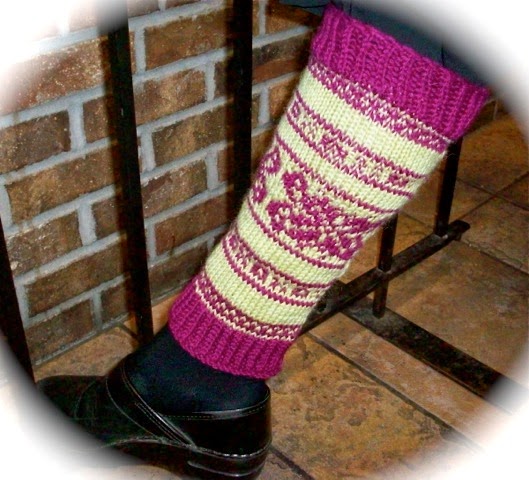
http://www.ravelry.com/patterns/library/butterflies--kisses-leg-warmers
 
Do you look at other designers' work or are you afraid that you will be influenced by their designs?
Oh I do look.  Sometimes I get inspired by a grouping, other times I just see what colors and styles are trending.  This winter I designed two cowls as it seemed that was all my knitting group wanted to work on.


How do you feel about the so called controversy of "dumbing down" patterns for knitters?
I'm very mixed on this subject.  If you look at patterns from 40 - 50 years ago they assumed the knitter knew quite a bit and to my best knowledge there were a lot of knitters then so the 'pithy' directions didn't stop them. Today's knitter wants more explanation than that.  My best test knitter, who passed last summer, was an expert knitter, yet she wanted me to do more explaining.  So I try to include at least an abbreviation section and list the main stitch techniques needed and add more explanation to the 'easy' patterns which I expect more beginners to be using.


Could you tell us about the book proposal that you are currently working on? 
Sure.  I'm working on a book, whose title right now is I-cord Mania.  It includes patterns using I-cord cast-on, bind-off, edging and my own Internal I-cord.  I'm not a writer, so I have been procrastinating by designing more patterns for the book.  In the long run that's a good thing but in the short, it doesn't get my proposal out there.  However, I'm now very close.  I have the intro written and a chapter on making a swatch using the methods.  I've started a Technique section and am putting the pics together.  I have about 8 patterns ready to go which, hopefully will be enough to get this accepted by a publisher.


http://www.ravelry.com/patterns/library/city-lights-shawl

You are known for having "un-vented" an internal I-cord which has been featured in a number of your patterns. Could you tell us the story behind the un-invention?
Some of you may know of a sewing technique / feature called a welt. You’ve most often seen it on western style shirts separating one section from another.  Usually it’s made by folding the ends of two parts of the garment over and together, then sewing them down making a nice delineation between two sections.

While thinking up Verve for Knitter’s magazine (K109, 2012), I imagined such a nice delineation between the sections without binding off and picking up stitches to make that thick line.  Boing!  I-cord.   So I searched and searched EZ’ books and then on the internet, finding I-cord cast on, bind-off, applied cording and edging but, alas no I-cord that did not have at least one side free. I thought about this for a while and then placed the instructions for cast-on (adding stitches) and bind-off (removing stitches) side by side.  “Hmmmnnn,” I said to myself, “How can I do both at once but still maintain the same number of stitches?” I worked each looking at how they formed.  AHA!  Put them together! That idea produced more than several false starts and frogged samples. However I made myself take exacting notes, which got themselves crossed out, erased and replaced. I fiddled and faddled but eventually my brain did figure out how to make my very own UNvention – the Internal I-cord.  It worked great for flat knitting but the skirt is knit in the round.  So there ensued more trial and error samples that, of course, led eventually to a fairly simple solution, which can be seen and knit in several projects in my proposed book.


You teach a number of classes related to knitting on the topics of spinning, spindling and dyeing, how has this affected your growth as a designer?
Knowing how yarn is made has made a big difference in my designing.  I'm known as a micron snob. :^)  Over the years I've become intimately acquainted with many kinds of wools from many kinds of sheep plus luxury fibers.  My favorites are Blue Face Leicester, silk, and cashmere, alpaca and angora blends. The down side is that I know that if a label only says wool that it's probably milled from the wool pool which is a mix of meat, milk and wool sheep fleece which makes it a harsher fabric than if only good quality low micron fleece was used.  As a result I only dye fiber and yarns that I consider 'next to skin' soft.


How many sample/test knitters do you have working for you or do you do it all yourself?
Sadly, my very best, fastest and most accurate test knitter passed away last summer and I haven't found anyone who meets those standards again yet.  I have one person who edits for me but the better test knitters nearby are slower than I would like so I wind up test knitting for myself which is not ideal.


Did you do a formal business plan?
Sadly, or not, no.  I don't know how to do one.  I do have goals but they are fluid and can change as the times change. Over the years I find I have gone from concentrating solely on dyeing to more pattern making and kits.

http://www.ravelry.com/patterns/library/circle-of-hearts-beret


Do you have a mentor?
I had a mentor when I started my business and he was invaluable. I learned so much from him, such as not rushing a customer, not walking around behind a customer being ready to help but by just saying,"Let me know if you have any questions." and by watching their faces as I did when I taught middle school.  I can see the questions forming so make myself available.


What impact has the Internet had on your business?  
I designed and edit my own website which takes a bit of time but is more responsive to whatever is going on. My business is split between internet sales and Fiber Fairs. June, July, Sept and Oct are Fair months and the rest of the year I rely on my newsletters and advertising.

Do you use a tech editor?
No, but I sure would like to meet one and work with that person.  I think my patterns would be oh so much better if I did.


How do you maintain your life/work balance?
When I started Spinning Bunny I was still teaching middle school, knitting through meetings and dyeing at night.  After a while I noticed that my teaching was burning out and that the part time, fledgling Spinning Bunny had increased to over 20 hours a week on top of the average 50 hours teaching week. I took a long hard look at what I wanted to do, what made me happiest and leaped.

http://www.ravelry.com/patterns/library/penelope-short-sleeved-shawl-collared-cardi


How do you deal with criticism?
I try to be mature about it but am just too soft inside I think.  However when the criticism is given with love and meant well, within a few hours or days I see what can be changed and do it willingly.


How long did it take for you to be able to support yourself?
Alas I am still working that one out.  I have a pension that pays my regular bills.  Until a couple of years ago, when the bottom fell out of the economy, Spinning Bunny was doing better and better each year and I was able to pay myself.  Fiber Fairs are still excellent but internet sales have dropped. More recently I have had to put money into the business.  Hobby crafting is a place the average person can pull back on when money gets tight.  We all have a large stash we can use.  I am hopeful we will pull through this to the other side.
I also can't see how anyone can make a living just selling patterns.  We need to also teach workshops to get our names out there and create a demand.  I see a book as another way to do that.


What advice would you give someone who wants to pursue a career in knitting?
The old adage of 'Don't quit your day job'.  BUT if it's something you love and you are seeing good feedback then slowly build it up.  One day you'll realize it has grown enough to support you and then you can jump in with both feet.  Networking with other knitters and designers is important too as is maintaining a connection with your local knitting and spinning community.


http://www.ravelry.com/patterns/library/bare-bones-toe-up-socks
             Sherbert and Ernie Socks in Bare Bones Pattern