Monday, June 30, 2014

How Facebook Decides What You See


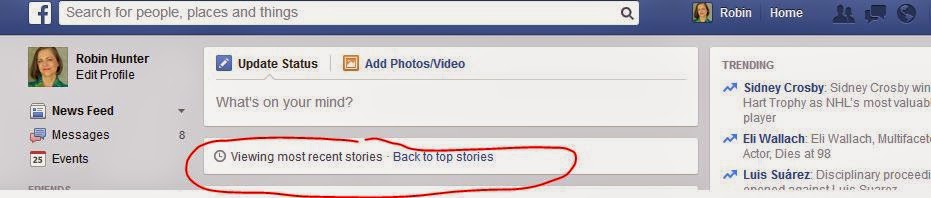
I’ve been noticing my Facebook feed keeps showing me the same postings everyday and I often don’t see things that friends mention to me. A week ago I went searching for background on how the news-feed works. I found this interesting article. I changed my feed to most recent from top stories. Then I reviewed the feed. I’m not interested in the posts about games and it turns out you can click on those and unfollow only the game related posts of your friends. I scanned the last 24 hours and saw lots of posts that I was interested in that I definitely did not see. Over the past 4 days I continued to check my feed and everyday they changed it back to top stories from most recent. Humm... Next I went to the pages for friends who appear to be absent from my feed and did a like on one of their posts and now I'm starting to see what they post in my feed.

I'm realizing that we can have an active influence on what turns up on the feed in a way that I'm sure most of us don't know about. 


Friday, June 27, 2014

An Interview with ...Maureen Foulds

http://www.ravelry.com/patterns/library/swirl-socks-3


Once a week I post interviews with interesting people about their insights on their experience of working in the Knitting industry.  I’ve noticed that every one of these individuals makes their living in a slightly different manner bringing their own unique presence to the knitting world.

You can find Maureen's blog here. She is here on Ravelry.

http://www.ravelry.com/patterns/library/and-then-there-were-mitts


Where do you find inspiration?
Inspiration tends to sneak up on me. It could be a photo, a comment from a fellow knitter, a colorful skein of yarn that knows what it wants to be. With my Agatha Christie collections, it's a book title or plot element which magically aligns with a stitch pattern.

What is your favourite knitting technique?
I love the beauty and magic of lace. The fact that one can create such beauty with sticks and string? Lovely!

You specialize in accessory patterns. do you have any future plans for garments?
Garments are part of my long range plan. While I've knit many cardigans and sweaters, I wear very few of them because they're either the wrong fit or I don't like the resulting fabric. Until I master the technique myself and produce garments I will wear, I don't feel like I can design for others.

http://www.ravelry.com/patterns/library/joanna-lymstock-shawl


Do you look at other designers’ work or are you afraid that you will be influenced by their designs?
I believe that as a designer you have to look at other people's work - how else can you continue to grow? Does an artist stop looking at other art, or a writer not ready anyone else's writing? I get inspired by other designers' creativity, which usually results in my thoughts spiraling off in its own direction.

How do you feel about the so called controversy of “dumbing down” patterns for knitters?
I prefer to focus on clarity. I try to make my patterns as clear and comprehensible as possible. I'm a technical writer by trade, so precise language is key. Whether I'm documenting how to use software or writing a pattern, I don't want my reader to be unsure of what to do next.
I also try to be cognizant of the fact that people of varying skill levels may be using my patterns. It's a tricky thing to find the balance between over-explaining or assuming too much. 

How many sample/test knitters do you have working for you or do you do it all yourself?
I always knit the first sample myself to work out the precise details. I'm a very visual person, so I find I need to knit it myself to see how the 2 dimensional chart translates into a 3 dimensional object.
I'm very lucky to have a large pool of test knitters to draw on for my designs. Many of them have test knit for me multiple times. Anyone can request to be added to my list of test knitters. When I have a design ready, I'll post a call for testers in my Ravelry forum, ear burn the list and see who is available.

http://www.ravelry.com/patterns/library/captain-hastings


Did you do a formal business plan?
Not a formal plan, no. But I know where I'd like to get to and the steps I need to get there. I've been a project manager in the software industry, so I apply those skills to planning out each phase of my design endeavors. 
Every once in a while I pause to evaluate where I am in my plan and whether I'm ready to add in the next step. 

Do you have a mentor?
No, but I've been looking for a suitable mentor. I have a few people in mind as potential candidates. But it's a big step which requires a lot of thought. The fit has to be right in terms of personality, skills and career goals.

Do you have a business model that you have emulated?
There are elements of different designers which I would like to emulate. I admire the way Amy Herzog balanced her daytime career with her design career and family, eventually being able to make designing her full-time profession. 
I also admire Kate Atherley's knitting knowledge, especially when it comes to socks! And the way she has been able to build up a full teaching schedule. That's something to which I aspire.

http://www.ravelry.com/patterns/library/wrought-iron-socks

What impact has the Internet had on your business?
My business wouldn't exist without the Internet. I rely on sites like Ravelry, Patternfish and Craftsy for making my patterns available and growing my audience. I use social media to maintain a presence and build awareness. 
And more basically - I use the Internet to stay connected to the vast breadth and depth of knowledge that is out there about knitting, design, techniques, running a business. I spend a lot of time reading various Ravelry forums, fibre-related blogs, online classes, and so on. That's how I gain insight into what other knitters think, what they like to knit, what they don't like in a pattern. It's how I find new opportunities for my designs. And it's how I meet a lot of talented people.

Do you use a tech editor?
Absolutely! I think it's a necessity for anyone who wants to be a professional.

How do you maintain your life/work balance?
It's difficult. I work full-time and have a family. I'm fortunate that I am able to work from home several days a week, which really helps me reclaim several hours back to the "life" portion of the equation. 

http://www.ravelry.com/patterns/library/interrupted-swirl-hat


How do you deal with criticism?
Chocolate! Actually, I welcome constructive criticism because I want to put out the best pattern I can. I know I'm not perfect and I know my weak areas. So when testers, editors or knitters point out errors or other issues, I'm grateful. I'd rather hear about any errors before I publish a pattern than after. 
My toughest test came back in May when Kate Atherley tech edited one of my patterns. She warned me upfront that she was blunt and honest in her edits and not to take it personally. I was nervous! But everything she pointed out - I was nodding my head and agreeing. Every point she made resulted in a better, clearer pattern.

How long did it take for you to be able to support yourself?
I'll let you know if/when that happens! I've been very fortunate to build a fan base after only 18 months of designing. But I'm nowhere near supporting myself yet.

What advice would you give someone who wants to pursue a career in knitting?
Don't do it to get rich. Do it because you have a passion for it. But also realize it's a business. You need to be professional. You need to figure out what makes your offerings unique. You need to figure out what image you want to project, how you'll market yourself, how you'll advertise and build your brand. 
Most important - approach it like a business not a hobby. Don't be afraid to charge for your time and skills. 

http://www.ravelry.com/patterns/library/dowagers-prize-diamonds

Wednesday, June 25, 2014

"Dressing well is a form of good manners." - Tom Ford


I've been thinking about this quote lately. I've recently attended several events that normally guests would dress up for. We have become a very casual world in the area of wardrobe but sometimes I feel we're slipping past enjoying personal comfort into disrespect. 

Etiquette is all about the expected behavior of members of society that demonstrate respect. The rules are there to make everyone feel comfortable. It's all about how you treat others. We should either be making people feel appreciated or being considerate of their feelings. 

I was at the ballet twice last month and spent an afternoon at a funeral. Most of the other guests were appropriately attired. It seems however, that there are always a few people who turn up looking like they are in the wrong place. I'm not thinking of those who are casual and tidy. I'm looking at the more extreme examples, of "I'm ready to work in the garden", take a nap in the "I'll just wear them one more time pajamas" or at the opposite end of the spectrum "let's get it on".  I'm never sure if they are making a statement or are being purposely contemptuous of the occasion? 

According to Emily Post  for funerals you should "Remember, though, that it is a serious occasion and your attire should reflect that, especially if you are participating in the service. At the very least it should be clean, neat, and pressed as for any other important occasion."

From about.com dance when attending the ballet the advice is, "Dress Appropriately. Although there is no specific dress code for ballet performances, most people try to dress up out of respect for the ballet. Some people prefer to dress in business attire while others prefer trendy, but casual, clothing. Formal attire is not generally worn. If you are attending the opening night performance, however, the atmosphere will be a little more formal."

The two pieces of advice above seem to be simple to follow. I enjoy dressing up. I enjoy the sense of occasion it brings to any event. I enjoy seeing others turned out fashionably. I'm not saying that those of us who dress casually most of the time are never appreciative of anything. However,our culture does seem to be demonstrating an indifference  towards many traditional occasions. I find myself wishing that social mores hadn't changed so much. I suspect it's reflecting a shift in what we value in modern life. Most of us still dress up when we feel that an activity warrants the effort. I personally will continue to do so and at the same time I'll feel a little sad for those who don't see the value in taking the trouble.


Monday, June 23, 2014

There's how Many Stitches in a Shawl?


A while ago a non-knitting friend surprised me by asking "how many stitches knitting projects require"? I was probably taken aback since the usual question is "how long did it take". I didn't have a good answer at the time. 

I did a little Internet searching and came up with this quote from the Yarn Harlot. 


“ It is a peculiarity of knitters that they chronically underestimate the amount of time it takes to knit something. Birthday on Saturday? No problem. Socks are small. Never mind that the average sock knit out of sock-weight yarn contains about 17,000 stitches. Never mind that you need two of them. (That's 34,000 stitches, for anybody keeping track.) Socks are only physically small. By stitch count, they are immense.”
 

Stephanie Pearl-McPhee, At Knit's End: Meditations for Women Who Knit Too Much

I was recently doing one of the many checks and rechecks I do on a pattern before it goes for tech editing. I was using an excel sheet, set up with formulas, to calculate the numbers. I realized if I added in more rows, I could get the total number of stitches the shawl required. The result was 25,442. Wow, even less than a pair of socks, for a triangle shawl that is 32 inches (81 cm) at center point and 64 inches (162.5 cm) across top edge.That larger needle and looser gauge really makes a difference. Yet at the same time, it took me way longer to knit than a pair of socks would. I always knew that somehow knitting has the ability to warp the space-time continuum.


Friday, June 20, 2014

An Interview with ... Dana Dodge of Got Yarn?


Prism's Foxy Cowl

Once a week I post interviews with interesting people about their insights on their experience of working in the Knitting industry.  I’ve noticed that every one of these individuals makes their living in a slightly different manner bringing their own unique presence to the knitting world.

You can find Got Yarn? here. Dana is here on Ravelry. 

All items in the photos are available from Got Yarn?


Tell me how you ended up running a yarn business?
I worked as an advertising art director for a dozen years after college. In 1994 I decided to freelance and see if I could earn my own keep. I was enjoying the entrepreneurial side, as well as the creative side, of my business. Since I was set up as a business and already collecting sales tax, I started buying close-out yarn from a few of the venerable US hand-knitting distributors. I was reselling to friends and acquaintances in order to support my voracious knitting habit.

In '98 I discovered EBay and typed in “yarn” and I got 7,244 hits. {I just now repeated that and got 174,837 hits.} I got really excited, so I listed a bunch of yarns immediately and sold everything in five days. That lead me to search for websites selling yarn. The results were sparse. Most were informational one page sites for LYS and they were not selling products online. Within a few weeks, I designed my website and placed ads in Vogue Knitting magazine. I launched GotYarn.com on July 1, 1999. The name Got Yarn?® is an homage to my background in advertising.

Do you run the shop by yourself or do you have employees? If you do how many people work for you?
For the past eight years I have been solo, wearing all the hats.

I ran a retail shop from 2000-2006. I opened the shop because Got Yarn outgrew my basement, and I saw it as an opportunity to buy yarn from the many retailers who would not sell to me, because I was only online. When I closed I had seven part-time employees, who were as good as gold to me, but it got to be too overwhelming, wearing way too many hats. So here I am back at my beginnings.

How did you choose the yarns that you carry in your shop?
I buy what I love; what I personally would knit if I have the time to knit it all! I gravitate to the high-end. I carry mostly natural fibers, and hand-dyed yarn. To be worth my time {and my customer’s time} it has to be top quality, exquisite and well-wearing.

Nicky Epstein's Koigu KPPPM Capelet


You focus on kits which include the yarn and pattern. Could you tell us about that?
Yes, kits are my specialty. I offer hundreds of combinations of projects and yarns in various colors, and I assemble them as they are ordered. A kit might include a single pattern, a back-issue of a knitting magazine, or a hardcover book with dozens of projects. The paradox of choice can make even buying yarn overwhelming. My customers love picking a project and knowing they are getting the right yarn for it. I offer a lot of kits from world famous designers. I get orders from all over the planet for Kaffe Fasset kits with umpteen colors of Rowan yarn, plus the pattern book. I special order custom kits too: a Prism sweater kit in their favorite hand-dyed colorway, a Jane Slicer-Smith coat in a choice of three lengths, one of Maie Landra's amazing garments for Koigu. I get a lot of special requests. Even if it's a vintage design, I will try to find them an appropriate substitute. I get a vicarious thrill helping them pick the next project to go on their needles.

I also kit some of my own designs, mainly simple sweaters and fun, no-gauge hats. I try to offer crochet as well, but there's never enough time for me to list everything I can offer.
Here’s a quote from a customer, Kathleen in Canada... "I really like the fact that you put together unique and interesting kits that are hard to come by myself. There is simplicity when you receive a kit in the mail. It sits ready for you whenever the creative juices arise."

What is the biggest lesson running a yarn business has taught you?
Just about every knitter I have ever met, emailed or spoken to on the phone is an honest, passionate person! I can't imagine a more positive business to be in. Every day, I am grateful I was given the gift of knitting to guide my life.

What is your favourite part of what you do running the business?
Buying the yarn – what else?


Kaffe Fasset's Fair Isle scarf and dress for Rowan

We've seen many cycles in the yarn industry with the market increasing and then falling again. What are your thoughts on where things might be headed now?
I am really happy that most of the suppliers I started out with are still going strong. It takes a lot of innovation and smarts to do what they do, season after season. That being said, along with everything else, the internet has created unlimited possibilities for knitting and crochet. No doubt, the business will continue to fragment. Now anyone can sell yarn to the smallest corner of the planet, designers can make a living selling their designs directly and wholesalers have created close ties to their end-users. The conventional wholesale-retail model will continue to evolve rapidly.

Did you do a formal business plan?
NO! I would have thrown in the towel years ago!

Do you have a mentor? 
My father ran his own business for 40 years, all by himself and he is now comfortably retired. He has always given me sound advice. Fortunately, he doesn't question me about all the yarn!


Lizard Ridge Afghan in Noro Yarn, designed by Laura Aylor

Do you have a business model that you have emulated?
My mother taught me to be nice to everybody, value creativity and buy quality, not quantity. I see my business as a fusion of her wisdom.

I have never put that down on paper before, but it's obvious now that both my parents taught me how to run a yarn business!

Did you take any courses in how to run a business before you opened?
When I started my freelance business I took a course on consultative selling. That means listening to your customers and helping them figure out what they want. Just about everything else I do here is self-taught. I've never even taken a single computer class. I am a fast learner and I've always operated by observation and intuition, figuring things out as I go along. I can easily get overwhelmed by too much information. Fortunately for me that doesn’t apply to my knitting. I love taking knitting classes and there's no such thing as too much!

Dana's Favorite Merino Yarn (Aurora 8) in her design Aran Mitts


How do you maintain your life/work balance? 
I try really hard not to answer the phone or check emails on weekends and holidays. Another plus about this business is that there are very few “yarn emergencies!” In advertising, the account executives treated everything like it was life or death.

How long did it take for you to be able to support yourself?
I was lucky in that I caught the “new millennium scarf craze” while I had my shop. That helped me build a cushion. So that was seven years into it. After that I was a single, self-employed mom for six years. Just about any small business is all about cash flow. Anytime I needed money, I would send out an email blast to my customers!

Koigu Linen Stitch Scarf by Churchmouse

What advice would you give someone who wants to pursue a career in running a yarn business?
Say goodbye to knitting something just because you want to. All your precious knitting time will be spent on projects that will be popular and move yarn. If you gravitate towards muted colors, get over it!

Debbie Bliss Baby Blanket


Debbie Bliss Cardigan


Monday, June 16, 2014

How to Create Chained Edges on Garter Stitch

Recently I had a question from someone who was knitting one of my shawl patterns. She wanted to check the technique for the slipped stitch edges.

I`m a loose knitter which can lead to sloppy looking edge stitches, mine have improved over the many years I`ve been knitting. Newer knitters can also struggle with loose edge stitches. The technique I use for slipping edge stitches creates a firm edge which looks like a crochet chain with a twist at the bottom of each chain stitch. I only use this technique on edges which will be exposed, not on those which will be seamed into a garment. I have also come across knitters who make beautiful edges in garter stitch, they probably wouldn't bother with this edging.

I create this edge by slipping the first stitch of every row purlwise and then moving the working yarn between the first and second stitch, then I knit the following stitches. On shawl borders I usually do a three stitch border, slipping the first stitch then I knit the next two stitches followed by my pattern stitch. At the end of the row I knit three stitches.   
Some knitters don't like the twist at the bottom of the chain stitch. If you want to eliminate it, add the extra step of ending every row by working into the back leg of the stitch. In my case that version creates a wider chain which stands out from the front plane of the knitting ever so slightly. The stitch also has a wider opening than the twisted version. I've noticed that results vary between knitters and with the same knitter when they move from one yarn to another or between needle materials.

I've included photos of my class sample. The best way for you to determine which version you prefer is to cast on six stitches. Knit 10 rows with no edge stitch, then knit 10 rows, slipping the first stitch of every row purl wise.  End by knitting 10 rows, slipping the first stitch of every row purl wise and ending every row by working into the back leg of the stitch.


If you enjoy reading my blog, I'd really appreciate it if you would tell your knitting friends or share links to your favourite posts online with Twitter, Ravelry or Facebook. Word of mouth is really helping to grow my business as knitters respect the views of other members of our community. Thanks!