Wednesday, January 16, 2013
Mainstream Fashion Hand Knits
I'm always curious to see high end retail hand knits. There are not a lot of items in this category and they seem to exist at two ends of the spectrum. Classic designs or totally out there designs that have most of us shaking our heads and wondering "what were they thinking".
The photos included in this post are from Neiman Marcus and can be found here. I found this garment very interesting. It has combined what appears to be three weights of yarn in one garment. I think there are actually two weights with one double stranded to make a third.
The increases in the center panel are very visible and I suspect they are meant to be. The garment is interesting but my guess would be that a knitter would never make something like this for themselves as it some ways it appears technically flawed to those of us who have spent time perfecting our technique.
I'm currently swatching an accessories idea that plays with varying numbers of strands of yarn, which may explain why this garment is thought provoking for me.
Labels:
Retail Hand Knits
Monday, January 14, 2013
The Knitted Art of Chris Motley
![]() |
| On Edge |
![]() |
| Anger |
![]() |
| For Dear Life |
![]() |
| Living Alone |
Chris also creates wearable art in the form of jewellery.
You can see even more pieces on her website.
Friday, January 11, 2013
Sweater Recipe
If you are like me, when you finish a hand knitted garment, you want to wear it everywhere. Many of us wear our clothes in one way only, always paired with the same items. Fashion consultants talk about how to develop wardrobe capsules and recipes. I've posted a flexible recipe above that works for me. I hope it will give you some ideas as well.
The cardigan is classic, it has a cable design. You can dress it up or or dress it down. Choose your footwear from the first row. and start by following the line down vertically. You have an outfit. Take note that the items are basic, simple ones that many of us already wear. They can be interchanged between the vertical lines. The only limitation is the length of the hems on the pants, they may determine your footwear by heel height. I choose black, white and denim. I could easily substitute in grey flannel trousers, a denim skirt or khaki pants. I could change the loafers to ballet flats or converse sneakers. Add jewellery that suits you and you are ready to go!
Labels:
Sweater recipes,
wardrobe capsules
Wednesday, January 9, 2013
Swatching a Storyboard
I've heard from lots of knitters who don't like swatching. I'm never really sure that I truly understand why. After all it's still knitting isn't it? I do get that everyone wants to jump into the project and how excited they are to start.
I think of my swatch as a story board. It allows me to test out stitches in a small scale. I can experiment with the details. I can see how two stitches look side by side or test increases and decreases. I like to see how they work with a stitch pattern in advance of the project. I can add a little band and see if the stitch ratio for pickups is correct. It gives me a chance to understand the fiber I'm working with. Rayon and silks behave very differently than wools. Yarns can bloom after washing. I once made a tassel for a bag that surprised me when the strands untwisted all the way to the knot and the tassel became fluffy while the bag stayed smooth and firm.
Labels:
Why you should swatch
Monday, January 7, 2013
Increases - Which Direction?
Which way do you go?
I've taught my Glove 101 class several times in recent months. It targets intermediate knitters who are beginners at knitting gloves. To teach as many skills as possible, students work through a sampler that gives them the opportunity to build a series of skills. I always get at least one student who tells me I have reversed the increases on the thumb gusset.
Increases exist to shape the knitting, making it larger or smaller. There are a number of different techniques for increasing. All are visible to the discerning eye but some are more obvious than others. Yarn overs can be used as a decorative increase, for example on a top down raglan. We normally work increases on the right (public) side of the knitting to have more control over the outcome.
In class we work the glove in stocking stitch using a M1R increase on the left and M1L on the right. I've looked at a lot of glove patterns to check what increase is recommended. Many patterns avoid the issue of which increase to use by giving the instruction as inc 1 with no specifics as to the intended increase. I see M1L and M1R (in that order) fairly frequently and on occasion I see them in reverse order.
The same issue comes up regarding sleeve increases. Most patterns leave the increase method to be used up to the individual knitter. What we are really asking you to decide is do you want the increase to slant in the direction of the increase in the work or do you want the slant to be towards the centre of the work. Some knitters are totally unconcerned by this distinction and use the same increase on both sides. I myself prefer paired, symmetrical increases.
However, there are no knitting police. I think knitting should be about pleasing the knitter so the choice is up to the individual. Whatever decision you make I do recommend that you be consistent within a single project. I further recommend that you practice as many versions as possible so you will always have an alternative method in your repertoire should you be unhappy with the results of a particular method.
To see increase video tutorial from knittinghelp.com go here. It includes a variety of methods that you can practice.
I've taught my Glove 101 class several times in recent months. It targets intermediate knitters who are beginners at knitting gloves. To teach as many skills as possible, students work through a sampler that gives them the opportunity to build a series of skills. I always get at least one student who tells me I have reversed the increases on the thumb gusset.
Increases exist to shape the knitting, making it larger or smaller. There are a number of different techniques for increasing. All are visible to the discerning eye but some are more obvious than others. Yarn overs can be used as a decorative increase, for example on a top down raglan. We normally work increases on the right (public) side of the knitting to have more control over the outcome.
In class we work the glove in stocking stitch using a M1R increase on the left and M1L on the right. I've looked at a lot of glove patterns to check what increase is recommended. Many patterns avoid the issue of which increase to use by giving the instruction as inc 1 with no specifics as to the intended increase. I see M1L and M1R (in that order) fairly frequently and on occasion I see them in reverse order.
The same issue comes up regarding sleeve increases. Most patterns leave the increase method to be used up to the individual knitter. What we are really asking you to decide is do you want the increase to slant in the direction of the increase in the work or do you want the slant to be towards the centre of the work. Some knitters are totally unconcerned by this distinction and use the same increase on both sides. I myself prefer paired, symmetrical increases.
However, there are no knitting police. I think knitting should be about pleasing the knitter so the choice is up to the individual. Whatever decision you make I do recommend that you be consistent within a single project. I further recommend that you practice as many versions as possible so you will always have an alternative method in your repertoire should you be unhappy with the results of a particular method.
To see increase video tutorial from knittinghelp.com go here. It includes a variety of methods that you can practice.
Labels:
How to choose increase direction
Friday, January 4, 2013
An Interview with....Lily Chin
![]() |
| http://fibertrends.com/product/0/101LCe/_/101LCe_Pinwheels_Berets_and_Toques_-_PDF |
Once a week I post interviews with interesting people about their insights on their experience of working in the Knitting industry. I’ve noticed that every one of these individuals makes their living in a slightly different manner bringing their own unique presence to the Knitting world.
You can find Lily here and here on Ravelry.
Where do you find inspiration?
It's everywhere. Not only visual material like
fabrics and architecture, but theories and principles. I actually do a
slide show presentation since *everyone* asks me this question over and
over again, I did this most recently at the Vogue Knitting Live Chicago
show as a 1 hour lecture during lunch. I show where the idea comes
from, then the resulting design.
What is your favourite knitting technique?
HA, who's your favorite child? It's whatever I happen to be working on, usually. I will say, Intarsia is one of my *least* favorite techniques
How did you determine your size range?
Since I travel excessively, both across the US as well as abroad, I know my "customer" well and I KNOW what real people look like. Thus, as early as 1995, I started doing expansive sizing and I'm pretty sure I was one of the first. In Knitter's magazine, I once did a 12-size pattern up to a 68" bust.
![]() |
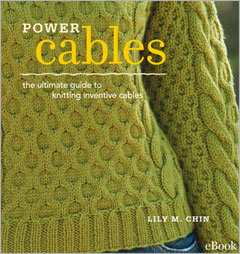
| http://www.interweavestore.com/Knitting/Books/Power-Cables-eBook.html |
Do you look at other designers' work or are you afraid that you will be influenced by their designs?
Kinda both. I try to keep a pulse on what's going on, yet I try to shield my eyes so that it doesn't seep into my subconsciousness. Tricky, I know.
How do you feel about the so called controversy of "dumbing down" patterns for knitters?
We have to appeal to a broad range of knitters and there's plenty of room for everyone. I do "mass" patterns for newer or more casual crafters, but there are plenty of designs that I do for the more advanced and technical person. We can have it all and one group should not begrudge another.
How many sample/test knitters do you have working for you or do you do it all yourself?
It is physically impossible for me to do 8 sweaters in a month. I have about a dozen people helping me out, more if you count crocheters as well.
Did you do a formal business plan?
No, just an informal one.
![]() |
| http://www.ravelry.com/patterns/library/textured-tote-baghttp://www.ravelry.com/patterns/library/textured-tote-bag |
Do you have a mentor?
I've had a machine knitting mentor but not a hand knitting one nor a crochet one. I've had general craft mentors, other artisans in other media such as weaving or quilting or embroidery.
Do you have a business model that you have emulated?
No, when I started back in the paleolithic age, there were not that many full-time knitters doing it for a living. As a matter of fact, back then (early 80's), designers very often never even got credited on the printed page.
![]() |
| http://www.interweavestore.com/Knitting/DVDs-Videos/Knitting-Daily-Workshop-Reversible-Cables-with-Lily-Chin-DVD.htmlhttp://www.interweavestore.com/Knitting/DVDs-Videos/Knitting-Daily-Workshop-Reversible-Cables-with-Lily-Chin-DVD.html |
What impact has the Internet had on your business?
Communications has been made really instantaneous. I don't rely on snail mail anymore. Conveying my ideas has vastly improved. Of course, pr and marketing is much easier.
Do you use a tech editor?
Yes, all the time. I can't live without tech editors. They are my friend.
How do you maintain your life/work balance?
I don't. I don't have a life. When I'm not knitting for work, I'm knitting for pleasure. When I'm not traveling for work, I'm traveling for pleasure. When I'm not on the computer for work, I'm on the computer for pleasure. What 's wrong with this picture ???
How do you deal with criticism?
Criticism? WHAT criticism? Kidding. I just ignore it . AH hahaha. Seriously, if it's made constructively, I consider it and try to rework and do something about it. If it's unfounded or just mean-spirited, well - put it this way. I've knit myself a very thick skin. My favorite quote comes from Major League Baseball's Reggie Jackson: "they never boo a no-body."
How long did it take for you to be able to support yourself?
About 6 years. I was able to start supporting myself in 1988.
What advice would you give someone who wants to pursue a career in knitting?
Don't quit the day-job just yet. It's tough.
ETA: Interweave just sent me a link to coupon codes for their store you can find the coupons here.
![]() |
| http://www.interweavestore.com/Crochet/Books/Best-of-Interwewave-Crochet.html |
Wednesday, January 2, 2013
Handknit Fashion
Here are some amazing knitted garments from Brazilian designer Helen Rödel's Spring-Summer 2013 collection. The collection is created with assistance from a team of six artisan knitters in Porto Alegre, Brazil. The site indicates the company has two founding partners who produce one exclusive collection a year.
You can find out more on their site here.
Labels:
Handknit fashion,
Helen Rodel
Subscribe to:
Posts (Atom)