Monday, January 31, 2011

The Ada Fanshawe Wrap


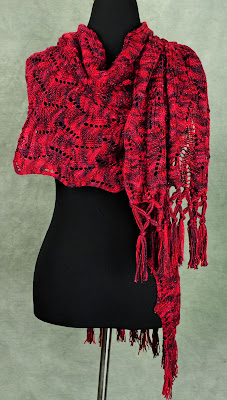
I have a collection of stitch patterns that I return to when I’m looking for inspiration. I’ve had this one a long time but I’m not sure what the original source was. It’s not exactly the same on both sides but it’s almost the same due to the little triangles made up of stocking stitch and reverse stocking stitch. It is reversible in that the so called wrong side is very nice and almost the same in appearance. The only difference in it is that  the K1, p1, k1 column reverses to P1, k1, p1. The pattern is easily memorized and has a nice flow once you get going. If you decide to knit this one don’t let the 24 row repeat intimidate you as the rows progress logically creating little triangles once you get past that first repeat. The edges have a pretty zigzag that adds vertical visual interest and slims your body by pulling the eye of the viewer up and down when it is worn as a shawl. The silk content of the yarn allows the fabric to drape so it is easy to wear as a scarf as well.  The instructions include both a charted and a written version of the stitch pattern so that you can use whichever format you prefer.


One of my friends test/sample knit this for me and told me that she enjoyed working on it. I've had a few people knit for me and I can't express how much fun it is for me when the project comes back. It seems like magic to hand over a swatch, a written pattern and the yarn and some time in the future get the whole thing back completed. I've knit so much over the years that having someone else create the item feels very odd (but wonderful). I'm new at this so right now I can only hand off simple designs that most decisions can be made on the swatch. I was thinking about adding a fringe or perhaps tassels to the finished wrap but I didn't add either to the swatch so when the completed wrap got back to me I realized that spacing would be simplified by utilizing the eyelets created by the yarn overs. 

I knit and write at the same time for my complex projects. Afterward I test my written instructions by working on something else to clear my mind and then going back and doing test swatches, knitting from my own instructions. Some projects get test knit at that stage and some don't depending on what I feel is needed to finish up the design before the tech edit stage.


When this wrap came back to me to be blocked  I could see there was still lots of yarn so I decided to finish it with a knotted fringe rather than the tassels I was considering. I really love the elegance of that type of fringe. I often debate fringe with a Knitting friend who always says "fringe is just a waste of good yarn." Oh well, we have to appreciate that not everyone sees these things in the same way. It was especially easy to add the fringe due to the eyelets at both ends created by the yarn overs of the pattern. I only had two spots that did not have an eyelet ready made and waiting for me. So in this case the fringes are perfectly spaced.


The yarn used came from Dye Version. You can find them here. There is more detail about the yarn here. Their description of the yarn states "This luxurious sock weight yarn with 2% real sterling silver fibres is perfect for Shawls and Lace projects.The subtle sparkle adds a touch of elegance for every affair."

 
The yarn is 20% silk and the wrap drapes beautifully because of that. I can't wait to wear it. 


Friday, January 28, 2011

An Interview with...Michelle G. Miller


Once a week I post  interviews with interesting designers about their insights on their experience of working in the Knitting industry.  I’ve noticed that every designer makes their living in a slightly different manner bringing their own unique presence to the Knitting world. 


You can find Michelle here and here.

Where do you find inspiration?
Everywhere!  But mostly when I’m not currently looking.

What is your favourite knitting technique?
Knitting lace, specifically the rhythm of knitted lace. 

How did you determine your size range?
I design accessories with one skein luxury yarns so most of my size ranges are determined by the size of the hank of yarn.  There’s something beautiful about a finished item that comes from only one skein of yarn.  At the end you feel like you’ve played a trick on the universe by creating something concrete out of what is universally held as not enough yarn.


Do you look at other designers’ work or are you afraid that you will be influenced by their designs?
I do my best to keep blinders on when it comes to the work of other designers.   When I do look I tend to be dazzled by the wit and creativity of others and usually come up feeling inadequate.

How do you feel about the so called controversy of “dumbing down” patterns for knitters?
I’m irritated by the expression. I am formally trained as a physicist and I hold a graduate degree.  I find that it takes more time, effort and thought to make something look simple than it does to express the same idea in a complex form that no one can understand.  If no one can knit your dizzily brilliant but complicated pattern, you haven’t communicated your idea in a way that will cause it to outlast you.

How many sample/test knitters do you have working for you or do you do it all yourself?
I knit all my own samples as part of my pattern writing process.  I am very lucky to have a large number of test knitters.  My successful test knitting/pattern testing relationship developed organically on Ravelry.  My test knitters have become my friends and acquaintances.   

A test knitter is presented with a set number of Fickle Knitter patterns after they complete testing of a new pattern as compensation as well as the pattern and item they test knit.  I prefer that my testers work from stash yarns and I give them the flexibility to finish the projects on their own.  They must be self motivated.  I use both a tech editor as well as pattern testers because I want to create the best patterns possible.

I have a trusted friend who I recommend as a sample knitter for yarn companies and knitting shops.  I am often asked for sample knitting and there are just not enough hours in the day for me to take sample knitting for other businesses when I’m so busy with my own.  The sample knitter relationship works out well because the shops and dyers have access to knitted samples and my time is use to focus on business tasks.


Did you do a formal business plan?
I do have a business plan.  When I started my business in 2008 I painstakingly wrote out the vision I had for Fickle Knitter Design. And about every six months or so I reevaluate where I am currently and where I want to go.  I forecast and make plans for at least one year into the future for my business.  This being said my plan is always in flux and I rarely end up where I thought I would go.  One of the most important aspects for my business is adaptability.  Particularly since so many knitwear designers are forging ahead in the digital frontier.  We are pioneers and require a great amount of flexibility because our marketplace is constantly changing.

Many of the goals I vocalized in the original plan have come to fruition but I still have a long way to go.  I have yet to write my first book, but I have met my goals for getting my patterns into the world, becoming a pattern wholesaler, and being published in magazines and contributing to books by other Authors.  Buried in the middle of my (not so) humble first business plan is a quote I’d like to share, by George Bernard Shaw:
“Forget about likes and dislikes. They are of no consequence.  Just do what must be done.  This may not be happiness but it is greatness.”

Looking back I am still inspired by my initial plan with new ideas and a perspective that I didn’t possess in the early days of my business.


Do you have a mentor?
I consider Elizabeth Zimmermann and Vibeke Lind to be my very first mentors, in the early days of my first attempts at knitting via their books “Knitting without Tears” and “Knitting in the Nordic Tradition.”  As a designer and business owner I’m very lucky to have been mentored by both Mary Beth Temple and Laura Crowley.  I also make it a point to mentor other designers. I get many questions from designers in various stages of their careers and I try to encourage them and help them as I have been helped and encouraged over the years.

Do you have a business model that you have emulated?
I did not have a prepackaged business model to follow.  Since the start of my business I’ve read books exhaustively on topics like marketing, business, and advertising. I started out reading David Ogilvy and used his book recommendations in “Confessions of an Advertising Man” as a jumping off point to find other reading material.  I also treat my online business as a Service based instead of Goods based industry and that’s the topic I’m currently researching.  The two books I’m reading now are “Marketing Services” by Leonard Berry and “The Marketing Imagination” by Theodore Levitt. Another book that has a lot of value in deciding on how to run a craft based business is “Creative Cash: How to sell your Crafts, Needlework, Designs & Know-how” by Barbara Brabec. Although the book was written over 30 years ago it still has insight that can be applied to craft business models today.

What impact has the Internet had on your business?
I wouldn’t have a knitting pattern business if it weren’t for the Internet. In fact I’ll go one further and say that I wouldn’t have a business if it weren’t for Ravelry.  It wasn’t until the genesis of the website that I realized that pattern writing is accessible and something that could be done.  Ysolda Teague and Rosemary Hill were the first two pattern writers who captured my attention as wildly successful  and prolific pattern writers. Both women have an avid following of devoted knitters and healthy businesses.  They were the pioneers that showed that a successful pattern business could exist and grow via the Internet.

Do you use a Tech Editor?
I was always nervous about the expense of a tech editor, and so for the first year of my business I relied only on test knitters.  Once I tried tech editing though I never went back. In fact I found that tech editing has so much value that I went back and  had all of my original patterns edited, even those that were initially test knit only.  The prices for editing are very reasonable and there really is nothing like another set of eyes to constructively make your patterns the best they can be.  I find that there is nothing as effective as having a new pattern both tech edited and test knit to prevent errors from sneaking in. However these sneaky little bastards do sometimes find their way into published work. At that point you must correct the mistake, and move on about your day.  Errata is something that plagues all writers, but specifically those of us who create detailed instructions for others.  I was once in a class with Meg Swansen where it was discovered that an error had crept into a pattern.  Meg with class and grace addressed the error and we all went on about our business.  So that’s what I aim for.

How do you maintain your life/work balance?
Not very well. When you have your own business there is no Monday through Friday, 9-5 business hour days.  I am always working on something business related and I travel a lot.  I try to be engaged in those precious little moments with my family but it’s hard.  Owning your own business requires a lot of money, time, and sacrifice to nurture growth.  A new business is much like the first few months of the life of an infant, requiring constant attention and care.  I feel though that it is the right path for me because the business brings fulfillment and I’m providing a positive role model for my daughter.  She sees me working at something I love and really going for it.  I hope that she thinks it’s perfectly normal for a woman to own her own business and work at it just like a man would.   

How do you deal with criticism?
First I cry bitter tears into my caffeinated beverage of choice.  Then after about a week I dry my tears and assess whether the criticism was constructive or not.  I follow my gut.  If I feel deep down that a criticism was not constructive I set it aside.  If I know in my heart and my gut that a criticism was valid I step outside myself and heed the advice.  I have experienced more personal growth from criticism than I thought possible.  We NEED criticism to grow.


How long did it take for you to be able to support yourself?
Hahahaha! Well my husband and I made the choice to become a one income family shortly after the birth of my daughter, Maya.  We still make sacrifices to make it all work.  We share a car, and we don’t buy the latest, newest, biggest gadget du jour.  My business is entering its third year and although it is solvent all the money made is reinvested back into the business.  I don’t get a paycheck, holidays or paid vacations.  I fly coach, eat non organic vegetables and try to be smart about money. In other words I’d be living pretty lean if I expected to be supported by a business that is still in its infancy.  My suggestion up and coming new businesses would be to budget in what you need to be paid when you are applying for loans and capital for your business.  It may take 3, 5, or 7 years before you see enough profit to take a paycheck home, all while putting in many more hours and making sacrifices that hourly employees don’t need to take.

What advice would you give someone who wants to pursue a career in knitting?
You’ll hear no a lot before those yeses roll in, but don’t let it stop you.  Be stubborn, tenacious, and knit like nobody is watching.


Wednesday, January 26, 2011

Jacek and Robin Make a Video


Robin Hunter Designs is working on their first video!

My husband thankfully took over photography duties as soon as I started self publishing. He's been having a lot of fun with it and every shoot produces even better photos. He is a big consumer of YouTube videos and decided that's what he wants to do next. So we spent a weekend videotaping me presenting step by step knotted fringing. We learned a lot while doing this. It takes way longer to set up and test the shots than the actual taping takes. We played a lot with lighting, experimented with surfaces to show my close up hand work and even played with my makeup a little. I can't wear my glasses as  the anti-reflective lenses still shine too much.  He is now working on editing and we need to add in some audio. It should be up in a few weeks.

Tuesday, January 25, 2011

The Prudence Crowley Vest


Updates

The photography is done and the pattern has been edited, its up on Ravelry here, Patternfish here  and LoveKnitting here.


The original yarn used here (Nashua Handknits Wooly Stripes) has unfortunately been discontinued. I'm often asked for suggested substitutes which then can be discontinued as well. As of, March 2013, many knitters tell me Taiyo Aran has been successfully substituted. As of Oct 2013 a reader tells me Mochi Plus from Crystal Palace Yarns is also an excellent substitute. Creative Poems Aran, Kaleidoscope, Odin and Filzwolle Fine Color appear to be an almost identical match to the original yarn. For current substitutes using Ravelry, do a search on 100% wool yarns, Aran weight, that are not discontinued. Put the word single in the search box at the top of the screen and you will get the current available yarn matches. Within those matches look for self striping yarns with long runs. 


I ended up wearing the vest to my monthly KNIT (Knitting Night in Toronto) group and I was very happy with it. I was given a shawl pin at Christmas that looks great on the vest so I wore it with the top edge folded back like a collar and pinned in the front the way it appears in the top photo. You can find the pins for sale here. My husband does the layout work on my patterns after editing so he made improvements to the schematic and the stitch legend before I uploaded it to Patternfish, Ravelry and LoveKnitting. I don't have much of a waistline, but look at what the stripes do in the top photo...they create one by adding in extra visual curves. I also noticed that if you leave it hanging straight that the vest hides fullness in the tummy area.


Monday, January 24, 2011

But is it Art?


I've been writing a presentation that I will be giving at my guild in March on why we knit. I've been reading a lot for this lecture and one of the books that I really enjoyed is pictured above. String Felt Thread by Elissa Auther. It  covers the history of the American art world during the movement of fiber work from the "low" world of craft to the "high" world of art in the 1960s and 1970s. It looks at the work of artists like Miriam Schapiro, Judy Chicago and  Faith Ringgold, as well as others who experimented with materials that previously had been dismissed for their associations with the merely decorative, with crafts and with women's domestic work. Auther specifically asks "What accounts for the distinction between art and craft?" The book discusses the roles of gender and race as they pertain to defining art. Auther looks at the shift in the art world from pictorial works to the acceptance of the modern installation pieces as well as the changing acceptance of the mediums that artists choose to work with.

I've also been thinking a lot about designer compensation. I've been convinced that at least part of the problem is one of gender. I've read all of Annie Modisett's blog postings on this topic and she indicates that compensation has been stagnant since the 80's. Nora Bellows has a posting here addressing the topic of why we want to support indie designers as well.  I had an interesting conversation with a peer about this topic and her view of the history of knitting design was pretty much the same as all area's where women were traditionally underpaid with justifications that have been reviewed during the women's movement. On one level this is actually a political discussion. I suspect that industrial designers like Karim Rashid don't have similar problems because their work is clearly accepted as linking art and design.

I'd be designing with or without compensation but to be honest making money from the work is partially about validity and credibility to the rest of the world. In my case, like many of my peers as evidenced in the interviews I do here on the blog, I have alternative income that allows me to pursue designing. I do think that what I'm doing is art. I get the same feelings of accomplishment and self expression that I did when I was taking art instruction and producing work in accepted art mediums that were non-functional and simply hung on the wall. I see the requirements of fit and flattery for the wearer as part of the development of my technique in the same way that I had to develop the techniques to work with water colour paints in a different way than I did when working with oils. We discussed this at the Pro-Knitters group I belong to and the other members also felt that they were artists.
What do you think, do you see your design work as art?


Friday, January 21, 2011

The Prudence Crowley Vest


Just before Christmas I started working on a vest pattern.  I was still working on the Evelyn Howard Scarf at the same time but I've discovered that my pattern writing improves when I take breaks from one project to work on something different.  It seems that I forget enough of what I'm doing so that on my next review of the pattern I notice misleading wording more often...  Or perhaps my brain just comes up with better ways of expressing the information if I let the processing go on in the background.

I've had some art instruction in my past experiences and it was common for a teacher to give assignments that had specific parameters of the medium to work in as well as certain "rules" to follow regarding execution.  I like that approach and I use it often to inspire my own creativity.  It forces my brain in directions that I might not have gone otherwise.

My goal for this vest was to develop something that is one step up for a beginner from a scarf and would be a garment that did not demand a great deal of fitting but could flatter a variety of figure shapes.  It had to require only basic skills, no complex finishing, no picking up for bands or buttonholes. I've realized that really experienced Knitters also love these kinds of projects for TV and social knitting where they want to work on something that does not require a lot of referring to a pattern.  That also means that the yarn has to do a lot of the work with interesting colour or texture.

I started swatching  with the Wooly Stripes yarn pictured above. I have a different colourway with fuchsia, burgundy, green and blue.  Now that I write patterns my first swatch is always in stocking stitch so I can confirm that I get the ball band gauge. The colours were gorgeous but a little too strongly striped for my purposes. I also wanted to avoid having separate knit bands so I needed a flat stitch. The front of the vest that I was envisioning shows both sides of the fabric depending on how it is worn so I also needed both sides to look good.  Next I tried garter and then a garter based lace that really didn't show up well with the colour changes. I switched to a simple knit/purl stitch combo and that really made the colourway zing. Unfortunately that doesn't show well in the photo below. The stitch also had the advantage of being easily memorized. That makes it much easier for the Knitter to incorporate new stitches or delete stitches while staying in pattern.  When I blocked my swatch the fabric looked great and laid very flat. I also got the same gauge as my first swatch.


I had an idea for a silhouette from a fashion show that I had seen. It was a jersey knit garment that I thought when viewed from the front was a scarf and then the model turned and I realized it was a vest. Cool!  I'll write more on this vest as the pattern progresses and let you know how it goes.

Wednesday, January 19, 2011

Knitted Jewellery from Elinor Voytal


Amazing knitted jewellery! 

Elinor Voytal has a degree in knitted textiles.  Her graduate collection  was made up of  jewellery pieces made using machine knitting techniques and intricate embellishment.  On her website she says that "Her designs are inspired by the fusion of hard metal and crystal elements into the soft, delicate and luxurious structures of machine knitted silk and viscose. She is interested in the way the embedding of metal findings or embellishment of Swarovski crystals changes the feel and weight of the fabric. The colourway for her graduate collection was taken from pixelised manipulations of her own photographs and she continues to use photography as inspiration."


You can find her website here.


Elinor was interviewed here if you would like to know more about her.