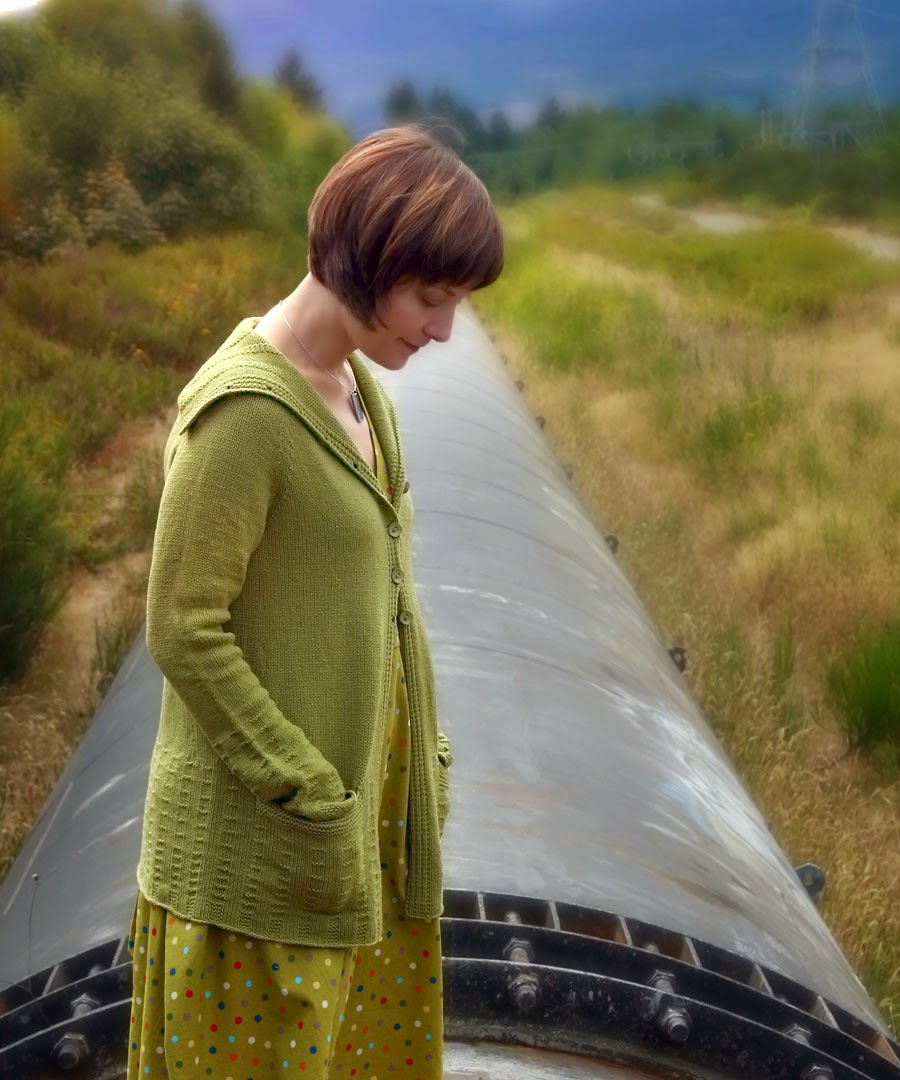
A few of my friends have made it their mission to find me more famous sweaters. These are the latest suggestions.
Are there any you don't recognize?
Other Famous Sweater posts:
http://knittingrobin.blogspot.ca/2010/10/more-famous-sweaters.html
http://knittingrobin.blogspot.ca/2013/05/i-may-be-going-over-edge.html
http://knittingrobin.blogspot.ca/2013/09/another-famous-sweater-part-3.html
Wednesday, April 23, 2014
Monday, April 21, 2014
How to Seam a Set in Sleeve Cap on a Knitted Garment
Full disclosure: I have a sewing/tailoring/pattern drafting background. The education I received in garment construction means I may see things differently than some other sweater designers. It doesn't mean that I'm right or they are wrong, it just means different designers have different approaches that will create slightly different results in fit and appearance. In general, those individuals with slim upper arms, don't need sleeve cap ease as much as those with a fuller upper arm do.
Setting in sleeves is often viewed as one of the most
challenging parts of seaming a garment.This is because the shape of the sleeve cap and the armhole are not an exact match. The height of the cap is normally shorter than the armhole depth but it's total measurement may be equal or greater in length to the armhole. For a more in depth explanation of sleeve cap and arm width relationships you can read my post here.
If you are working from a pattern it has predetermined that measurement relationship. Keep in mind that row gauge discrepancies will also have an impact here.
I design my garments with the extra length (usually about 1inch) and ease the sleeve cap into the armhole opening.
I seam the sleeves and the side seams of the garment first. I start to join the armhole and the sleeve cap by stitching at the underarm and I mattress stitch evenly across the sleeve and the armhole in the sections where the cast offs were worked. Each stitch is of the same length. Then I join the centre of the top of the sleeve cap at the shoulder seam. I use mattress stitch and seam evenly for a half inch on either side of the shoulder seam. Next I give the work a tug, aligning the two pieces and make note of how much longer the sleeve cap is. I use mattress stitch to seam from the armhole to the sleeve first taking a stitch on each side that is the same length. Then I begin to alternate making the stitches on the armhole side slightly smaller than those on the sleeve cap side. I make a guesstimate at the ratio of row to row numbers. If I run out of one side or the other before I'm finished with the sleeve cap I pull out the stitches and adjust the ratio between one and two row stitches on the armhole side. The goal is to ease the sleeve cap in without any gathering or bunching. Make note of the ratio for the other half of the sleeve and the second sleeve.
If the pattern you are working with was designed with no ease you will be able to seam without easing and all your stitches can be the same length.
Friday, April 18, 2014
An Interview with...Lara Smoot
![]() |
| http://www.ravelry.com/patterns/library/intersect |
Once a week I post interviews with interesting people about their insights on their experience of working in the Knitting industry. I’ve noticed that every one of these individuals makes their living in a slightly different manner bringing their own unique presence to the Knitting world.
You can find Lara here and here on Ravelry.
Where
do you find inspiration? I find inspiration everywhere and keep a
notebook with me for jotting down ideas.
The wings of a butterfly, the spiral pattern of a shell, frost patterns on windows, looking at the way colors flow in a skein of
variegated yarn all give me inspiration.
I enjoy reading fashion magazines and get a lot of inspiration from them
as well.
What is your favourite knitting technique? Lace! I love knitting anything with lace incorporated into it. I also enjoy colorwork. My favorite projects are socks and shawls.
Do
you look at other designers’ work or are you afraid that you will be influenced
by their designs?
I subscribe to several knitting
magazines and always read Knitty
when it comes out online. I think that as a designer it is important to stay on
top of what is trending and to know what knitters want to knit. While I do
enjoy looking at other designs, I strive to create new and unique designs.
How
did you determine your size range?
It really depends on the design.
A shawl may offer one or two sizes,
while a sock pattern will have a wider range of sizes.
Could
you tell us a little about your Etsy business? My Etsy
shop is very similar to my Ravelry Pattern Shop. I carry a full line of my patterns on both
sites. I will be adding a new line of
knitting bags to my Etsy shop at the end of April.
How
do you feel about the so called controversy of “dumbing down” patterns for
knitters? I
think that patterns need to be presented to knitters in a way that is easy for
them to follow and understand. I strive to have clear and concise directions in all of my patterns. Knitting should be enjoyable and trying to
knit a pattern that is hard to follow can be very frustrating. Many times
knitters just give up.
How
many sample/test knitters do you have working for you or do you do it all
yourself?
I have a group of wonderful test knitters.
I have three test knitters that knit almost everything that I come out
with and there are several other test knitters that test knit when time allows. They all do a fantastic job with testing and
I don’t know what I would do without them!
I have one sample knitter and I knit each design that I come out with.
Did
you do a formal business plan? I do have a business plan. It is based over five years and includes an
intensive marketing campaign. I worked
in social media for a yarn company for several years and my marketing strategy
is very similar to the one that I created for them. It’s good to re-evaluate your business plan
every five years or sooner, make changes where you see the need, and go from
there.
Do
you have a mentor? I feel very lucky to have a few: Anne Hanson, Carrie Sullivan,
Kyle Kunnecke,
and Tabetha
Hedrick. It can be difficult to break into designing and I was fortunate enough
to be able to turn to friends when I had a question or needed encouragement.
Do
you have a business model that you have emulated? My
business model is based on customer relation's and support. First and foremost I want to be able to
provide a high level of service to people who have purchased my patterns. I love what I do and hope that it shows
through in my work. If someone has a
question I make sure that it gets answered in a way they can understand –
especially if they are new to knitting.
We were all new to it at one time and I think that sometimes that gets
overlooked.
What
impact has the Internet had on your business? My
entire business is on the Internet.
Ravelry specifically has made it very easy for designers to self
publish. Ravelry has a wonderful
advertising program that I have taken full advantage of. With the addition of Etsy,
Facebook and Twitter reaching potential customers is now much easier then it
was even just a few years ago.
Do
you use a tech editor? Yes.
I have a wonderful tech editor who does a fantastic job for me.
How
do you maintain your life/work balance? I really enjoy what I do and it
most of the time it doesn’t feel like work.
I try to stick to a schedule of writing in the morning and early
afternoons, and knitting in the afternoon and evenings. This changes if there is a deadline or we are
traveling. It’s really hard to write
patterns while we are on the road.
Knitting is a wonderful craft since it is portable and can be brought
most anywhere. It’s not often that you
will see me without it.
![]() |
| http://www.ravelry.com/patterns/library/the-outer-limits |
How
do you deal with criticism? I continually strive
to improve myself and my patterns.
If a test knitter has a suggestion or has trouble understanding
something that I have written, it means that I need to improve what I have done
before publishing. I want my patterns to
be clear and easy to follow.
How
long did it take for you to be able to support yourself?
I am not there yet, but am certainly striving to be able to do this. Right now it’s providing a small and steady
income and I am doing something that I absolutely love. I am fortunate that my
husband is very supportive and encouraged me to take the first step that lead
me to designing full time.
What
advice would you give someone who wants to pursue a career in knitting? Take
as many classes as you can, attend events like TNNA and Stitches. Get your feet wet by offering to
test knit for designers whose work you like.
Make a business plan and know where you want to be next year and five
years from now. Don’t ever be afraid to ask for help. People are usually willing to offer advice
and suggestions. Most of all don’t ever
get discouraged.
![]() |
| http://www.ravelry.com/patterns/library/spark-2 |
Thursday, April 17, 2014
Contest Winners Nancy Whitman Patterns
![]() |
| http://www.ravelry.com/patterns/library/eden-prairie |
TrishD, Tobie and Lori are the winners of the Nancy Whitman pattern contest.
Tobie and Lori please email me. (Email address is at the top of this page).
Thanks
Labels:
# knitting blogs,
Nancy Whitman,
pattern contest
Wednesday, April 16, 2014
Easter Knitting - Will you be Knitting any of these Eggs?
![]() |
| http://www.purlbee.com/the-purl-bee/2014/3/30/whits-knits-chick-in-an-egg.html |
I saw some really cute Easter egg knitting on The Purl Bee blog. I had to see what else is out there. Here's the Ravelry search and two of my favourites.
![]() | |
| http://www.ravelry.com/patterns/library/russian-spring-easter-eggs |
![]() |
| http://www.ravelry.com/patterns/library/knit-n-felt-ornaments |
Monday, April 14, 2014
My Husband Doesn't get Knitting Humour
![]() |
| https://www.etsy.com/ca/listing/68768396/knitters-eye-chart-tm-knitter-gift-idea |
One of the things I follow on Pinterest is knitting humour. Many of these items make me laugh out loud. Laughing leads to my husband wanting to share the joke. My husband is very interested in my knitting. He does the photos for my patterns, he checks for layout improvements, he does a little copy editing after the tech edit and he is working on a new logo for Robin Hunter Designs. But he just doesn't get the humour. All I get is a blank face when I share these items. Thank goodness I have lots of knitting friends!
Labels:
how to knit,
Knitting blogs,
Knitting Humour,
knitting patterns,
yarn
Friday, April 11, 2014
An Interview with...Megan Goodacre
![]() |
| http://www.tricksyknitter.com/product/arbois-cardigan/ |
Once a week I post interviews with interesting people about their insights on their experience of working in the Knitting industry. I’ve noticed that every one of these individuals makes their living in a slightly different manner bringing their own unique presence to the Knitting world.
You can find Megan here and here on Ravelry.
Where do you find inspiration?
Inspiration
is a funny thing for me, it tends to wander. Right now, I'm loving the
period wardrobe in Bletchley Circle, a post WW2 mystery TV series. I
don't know who designed the wardrobe, but the number of hand knits on
the show is astounding. I think there's an old-fashioned part of me that
likes sweaters to be a little vintage. The Arbois cardigan, for
example, was partly inspired by an illustration by E H Shepard. There's
something distinctly Christopher-Robinish about the collar.
And
I love browsing the web for the latest couture; the fashion industry is
fascinating to me. The pressure that fashion designers are under to
produce hundreds of fresh designs every season is baffling. I love
anything layered, tailored, vintage, or simplified.
Sometimes,
I look for inspiration in geometric patterns; I like the idea of using a
single visual element as simply as possible and turning it into a
piece.
How did you determine your size range?
Knitting
patterns tend to have a wide range, from, say, a 30 to a 60 inch bust. I
have mixed feeling about this range. I like the idea of all-inclusive
patterns, but I'm not sure it's always appropriate. Growing up, I sewed
much more than I knit. With sewing, you learn to tailor to fit yourself.
Commercial sewing patterns are designed to be altered, with
instructions and markings ("lengthen or shorten here", "place darts
here", etc) and the experienced seamstress (or seamster, if that's the
masculine version of the word) is always perfecting their fit. On the
other hand, we tend to treat knitting patterns more literally. There's
so much to think about—gauge, stitch counts, dimensions, yarn—that it's
easy to get to the end of a sweater after following it to the letter but
without having tried it on, only to discover that it doesn't fit! Or
maybe it fits, but doesn't flatter.
I size my
sweater patterns following the American publishing convention, to fit
about a 32 to 54 bust. But I think anyone knitting a sweater should
customize their patterns to flatter your shape. Measure something you
own that you love. Then use the written pattern as a foundation and work
it to fit.
Do you look at other designers' work or are you afraid that you will be influenced by their designs?
I
love looking at what other designers are doing! We're all
re-interpreting the same basic things: sweaters, scarves, shawls, hats. I
enjoy seeing how other designers are coming up with new combinations.
And when I have a sketch, I want to make sure that it hasn't already
been done. When everyone is using the same ingredients, it's inevitable
that coincidental repeats happen, but I avoid it if I can.
How do you feel about the so called controversy of "dumbing down" patterns for knitters?
Hmm, that's a tricky one.
Compare
today's patterns to patterns of 20 (or 30 or 50) years ago. Now,
they're written more plainly, with a lot more detail. Explanations are
provided for everything but the basics. The technical skill required is
often high, with short rows, provisional cast ons, complex lace and
cables, steeks… And knitters are producing incredible works. These are
no boxy hand knits; these are exquisitely crafted garments. I don't
think this would be happening without designers' putting a lot of work
into instruction and pattern support (whether through blogs, or KALs, or
discussion groups).
On the other hand, this
demand for instruction puts a lot of pressure on the independent
designer. A lot more time has to go into the pattern before and after
publishing, and testing gets more complex. And most designers are
working on tight budgets with small revenues. 20 years ago, if I didn't
understand something in a Rowan pattern for example, I didn't have the
option to email the designer for help.
Ideally,
I would like to see the technical and design aspects separated.
Technical instruction could go in blogs, books, workshops. And the
design could be left in the pattern. Remember what a revolution the
Kaffe Fassett designs were, and how successfully they attracted
knitters? That was all about visually exciting design; the technical
aspects were very simple.
I try to manage the
issue by putting tutorials in my blog. Then I can include a link to the
tutorial within the pattern. For example, I have a hat pattern in the
works that uses stranded colour knitting. Some of the testers felt that
the pattern should include information about colour dominance. But I
prefer to make this optional (I don't think colour dominance matters
unless you're very particular about the finished product) so I wrote an
article about it on my site.
How many sample/test knitters do you have working for you or do you do it all yourself?
I often turn to Ravelry for test knitters,
and have worked with many very helpful volunteers. They don't just test
the pattern, they get involved with the finer points and usability of
the pattern, like a focus group. It's great.
Did you do a formal business plan?
The
first year was really about finding out more about the audience.
Finding out what people are looking for (or not) and where the potential
revenue is. Now that the site is up and running, I have a loose plan
and projections for the different parts of the business. The business
runs on individual pattern sales, royalties, freelance commissions, ad
revenue, and notebook sales. And of course, it's hard to plan for
unexpected work, like being asked to write the Idiot's Guide! That was a
real bonus for me!
What impact has the Internet had on your business?
And
I've been a web developer/designer for about 15 years, so am very aware
of changes that have happened in the last decade. The idea of selling
virtual, digital goods, wouldn't be possible without the Internet. My
mom ran a small home business pre-internet, so I grew up with cottage
industry. The "cottage" in small crafts business probably doesn't exist
so much anymore, but a lot of other aspects are the same. And the
Internet allows the crafts person to reach a much bigger market than they
could through crafts fairs or traditional retail.
How long did it take for you to be able to support yourself?
(I still augment my knitting design business with graphic design, you can see some of my work here: www.megangoodacre.com)
What advice would you give someone who wants to pursue a career in knitting?
Career
in knitting? I won't sugarcoat it: there is little career to be made
from making things by hand, especially with something as time-consuming
as knitting. It's a cold truth that is better to face before starting.
There are exceptions of course, and there is some livelihood to be made,
but it's getting harder.
Career in design?
That's where the potential is. But if you're doing this for a living, or
a partial living, be prepared to be business-minded. Creativity and
craft are only part of the picture.
My advice:
Face the hard truths before, not after. It's such a
drag, I know, but ask yourself, how much do I want to get paid an hour.
Ask yourself, do I want (someday) to do this for a living? Then, take
those numbers, and do the math. How many patterns would you have to sell
every month to meet your goals? How many designs would you have to sell
to magazines every year?
Then, if you've done
the math and girded your loins, figure out what your niche will be. Or
as I like to say, figure out what your racket is. And then investigate.
You might think your niche will be classic knits for men. But you'll
find that there's not a big enough market there. Or, you might want to
write nothing but cardigan patterns. There's a big market there, but
lots of competition.
Once you've figured out
what you want to do, start building your aesthetic and your personal
brand. It's helpful to sit and write a 100 word description of the
designer you are (or want to be). It helps you to focus on what you're
all about.
And finally, don't go it alone if
you don't have to! Reach out to other people in the industry for advice,
yarn support, and freelance work! I couldn't have done the Idiot's
Guide without Knit Picks; they generously provided all the yarn for the
book.

Subscribe to:
Posts (Atom)