Monday, July 15, 2013

Tips For Better Button Bands Part 1

http://www.ravelry.com/patterns/library/the-emily-brent-cardigan


Many knitters are afraid to take on the challenge of knitting cardigans because the thought of creating the bands is overwhelming. However learning these skills are necessary as bands are essential in the finishing of knit garments. Bands counteract the structure of knitting which tends to roll at the edges or stretch out of shape. 

Bands should be knit in a smaller gauge to be firmer to support button weight and sweater fronts. Bands can be created for garments in many ways. They can be knit at the same time as the garment is knit or they can be picked up and worked out in the opposite direction. Bands can be knit separately in the same direction and joined to the garment as they are completed. Bands can be knit separately and sewn on. They are often best worked in flat, non curling types of stitch construction like garter, rib or seed stitch. Bands should be a controlling factor on the garment; they should keep the center front edges in alignment and pull the garment in, ever so slightly, around the neck of the wearer. A too loose band will ripple and stretch the garment out of shape. A too tight band will make the garment pucker and in the case of neckbands, make it difficult to put on or take off. Wool lends itself to the creation of excellent bands due to its elasticity and good response to blocking. Other fibres have their own properties to be considered. Making use of different techniques and swatching to test for the best method can solve any difficulties that other fibres create.

Buttons should sit at the center front of the garment. The centering of buttons will add to a garments symmetry on the body. In order for this to happen, the bands are extended beyond center front and they overlap. The overlap should be slightly larger than the diameter of the button. This creates an ideal proportion between the button and the edge of the garment. The accepted standard is, when the garment is closed, the amount of knitted fabric that shows beyond the center of the button should be roughly equal to the radius (half of the diameter) of the button plus ¼ inch. These standards come from the sewing world, however in knitting we are ruled by gauge, so often knitters need to fudge the rules a little. 

Generally it’s best to go with less not more band showing when evaluating the possible options. To size the band the usual method is that the front of a garment should equal ½ the width of the back minus ½ the width of the band. Knitting patterns tend to bend the rules a little. Again the constraints of gauge enter into the calculations and pattern drafting for knitwear is simplified as compared to drafting for woven fabrics.


Vertical buttonholes are used when a garment fits closer to the body, and horizontal buttonholes are used on heavier weight, looser fitting garments. Horizontal buttonholes prevent slippage in the opposite direction, keeping the garment bands aligned at the top and bottom. Vertical buttonholes prevent horizontal slippage, keeping the bands centered on top of one another. Occasionally there is a combination of the two varieties; most often when a final top buttonhole in a neckband is added after the vertical bands have been completed. Horizontal buttonholes are worked so the outer edge of the buttonhole is centered on the garment. This is because while being worn, the button pulls to the outside edge of the buttonhole. This off center placement keeps the bands aligned.

I'll be writing more on this topic in the weeks to come. The links to the next parts are listed below.

Part 2

Part 3  

Part 4

Part 5

If you enjoy reading my blog, I'd really appreciate it if you would tell your knitting friends or share links to your favourite posts online with Twitter, Ravelry or Facebook. Word of mouth is really helping to grow my business as knitters respect the views of other members of our community. Thanks! 

Friday, July 12, 2013

An Interview with... Mary Cullen


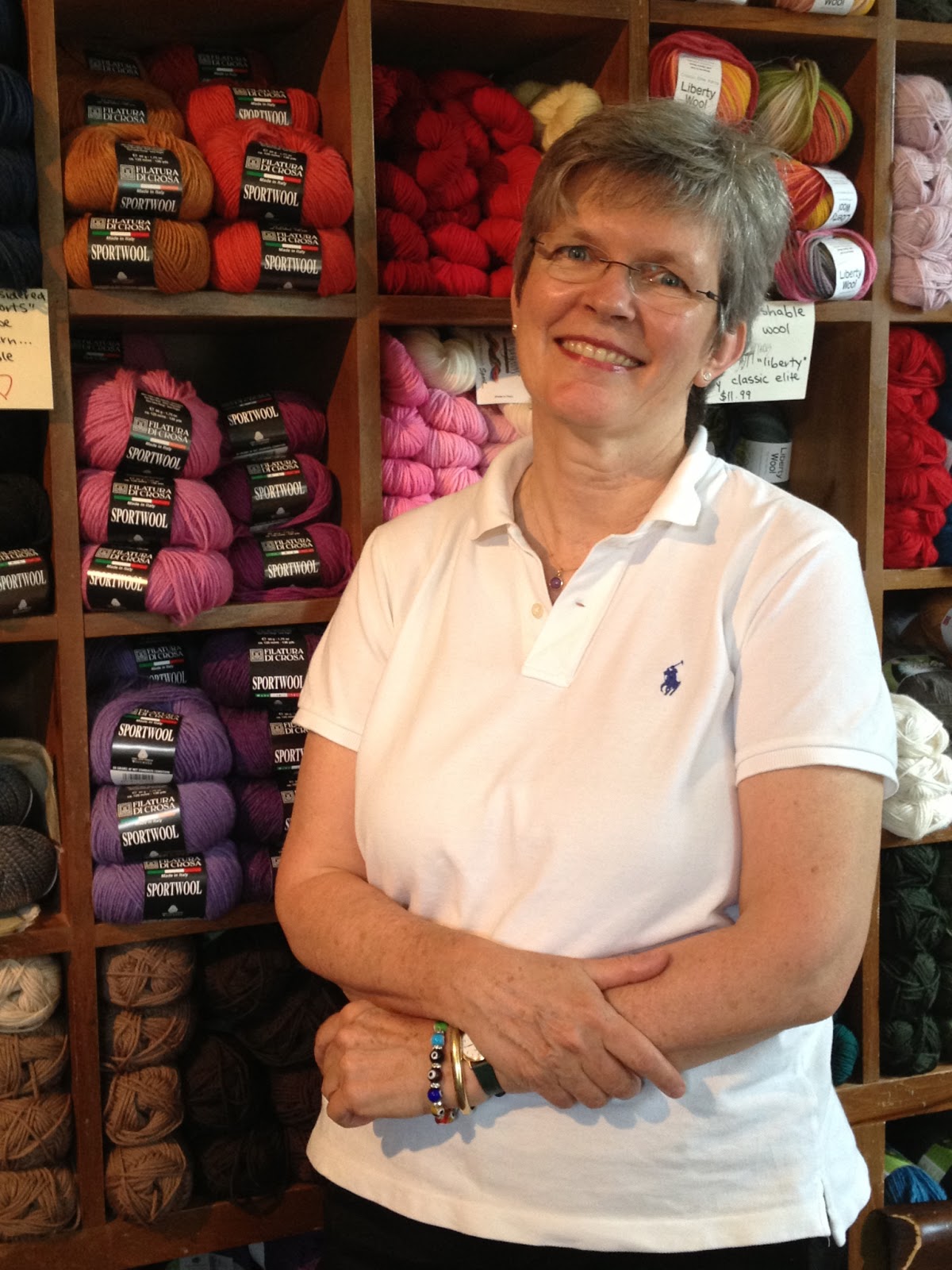
Mary


Once a week I post interviews with interesting people about their insights on their experience of working in the Knitting industry.  I’ve noticed that every one of these individuals makes their living in a slightly different manner bringing their own unique presence to the Knitting world.

You can find Mary here and here and here (sock knitters) on Ravelry


Tell me how you got into the business of running a yarn store?
That's a funny question because I should be able to answer it…..but I really don't remember. It had been a dream for years and anytime I was out for a drive..I would envision just about any property I saw, as a yarn shop.

One day an old building on Main Street , Unionville became available and before I knew it…….I was on my way to opening a yarn shop. Truthfully, it was Easter weekend and I think I was a bit preoccupied with getting a big dinner and hiding the eggs!
 
How long have you been in business?
I got the property in June 2002, but didn't open until the end of February, 2003.  The old house (built in 1876) was a disaster and needed painting…top to bottom. We also landscaped, etc….then I started buying inventory, so I have been open for just over ten years.

Do you run the store by yourself or do you have employees, if you do how many people work at your shop?
My daughter, Lynn joined me 4 years after I opened. The two of us run it…..but we have 3 delightful part-time employees.

How did you choose the yarns that you carry in your shop? 
How do we choose?……"rapid fire"……..we know very quickly if it "feels" right. That doesn't mean we always make the right decision…but we don't spend too much time thinking about it.  Price is a big factor and Lynn and I each choose half of the colours we order…she likes the brights…while I tend to go for the earthier tones.  After being in business for ten years….you do start to have a feel for what your clientele will like. 

What have done to create a sense of community in your store?
….a sense of community comes from doing our best to remember people and being truly interested in their stories. We like to introduce knitters to one another if we feel they have a common bond…we also have a group that meet in the upstairs room at the shop , every other Wednesday afternoon. 

Our classes and special events tend to bring out many of the same people…..so eventually they get to know one another. It's fun to hear two customers making plans to meet at one another's homes….to knit. Helping friendships form, can only help a community.

What is the biggest lesson running a yarn shop has taught you?
The biggest lesson….not everybody shops like me!     Seriously……I am intrigued by all of the different ways people approach a project, so I must keep that in mind when buying.

What is your favorite part of what you do running the shop?
Organizing and merchandising.  I love tidying the yarns and lining them up in such a way that people are drawn to the colours and the textures…..but I love the interaction with the customers…and suppliers……it's fun to find a deal and pass it along to customers…or a new yarn……I honestly love everything about "running" a yarn shop……..

We've seen many cycles in the yarn industry of the market increasing and then falling again. What are your thoughts on where things might be headed now?
I think we're in a better place than we've been in many years because so many people have gotten into knitting in the past 15 years……it's beyond being a fad and while it may have some dips….I don't think we'll see it get anywhere close to disappearing in our lifetime……..especially if Rowan keep putting out their beautiful books! 

Did you do a formal business plan?
No formal business plan.  

Do you have a mentor? 
Ah yes….my husband is my #1 mentor. It's all we talk about….retail...……and both of our fathers were in retail…so I often stop and run questions by them in my mind…as they have both passed away…and I try and guess what they would say. My kids are also wonderful for being honest and up to date…..so their opinions matter a lot to me. 

Do you have a business model that you have emulated?
Not really…….maybe snippets of one store and snippets of another……I love to watch some of the larger stores, but their conditions are so different from mine….that emulating is not really an option.

Did you take any courses in how to run a business before you opened? 
Not recently, but I did major in Home Ec  at Guelph..thinking that I wanted to become a sewing/cooking teacher.  After a year in the course and the trend away from teaching Home Ec in the schools…I switched to Consumer Studies. This course supplied me with much of the basic info I needed for running a shop…otherwise…it's a gut feeling and a great mentor! 

What impact has the Internet had on your business? 
The Internet…….I was more aware of it when I opened 10 years ago……people were discovering the Internet and me at about the same time…. 

I guess it's safe to say that I felt threatened by the Internet when I first opened…but honestly…I think we have it to thank for the huge increase in the number of knitters. It's so great to be able to refer to You Tube or Ravelry when we're stuck.  It's so much easier to help a customer find the right yarn now that we have Ravelry at our fingertips…..it sure beats saving all of the old yarn catalogues for reference!!  It's a "win/win". 

How do you maintain your life/work balance? 
Work/Life balance…….does anyone have the answer for that?  My 4 kids are getting older and moving out…so that makes it a bit easier…….but now there are new challenges….so I really can't advise on that. Funny thing….I am actually more relaxed at the shop…..I go there to chill. 

How long did it take for you to be able to support yourself? 
Support myself……or my yarn habit?  Thankfully, my family is not counting on my income from the shop…….but we are finally in a spot where one of us can take home a decent pay cheque. 

What advice would you give someone who wants to pursue a career in running a yarn store? 
Advice?  Not really….every person and every yarn shop/location is so different…….that's what makes it all so interesting…

Be patient in the early years…….it does take some time to see your business generate a positive cash flow.

Do your best to be friends with  neighbouring yarn shops……..it's so much nicer if everyone can work together.

It's hard work…….but we love it.


Thanks Robin for inviting me to answer these questions. It's a great exercise and only reinforces how happy I am that I decided to open the shop. I've had my moments……but overall, it's been a joy. My biggest fear before I opened was that I would lose my love of knitting. That has not happened for even a fraction of a second….it's been wonderful to meet so many knitters…see their projects and hear their stories.

Lynn, Mary and Karen

Wednesday, July 10, 2013

Learning to Knit Cardigan Bands - Deliberate Practice

If you want to develop your skills in any area psychologists suggest using deliberate practice techniques. In a recent class we discussed how to get good at knitting cardigan bands. I suggest a three step approach. Deliberate practice
suggests breaking down the skills required and focusing on improving those skills step by step. As each step is completed it is imperative to analyze what you were successful at and what areas to focus on improving in the future. If you focus on the successes, you build confidence that will keep you moving forward. At the same time you must continually practice your skills at more challenging levels to improve the final results and become an expert. 

Step One

Knit a cardigan with a band that is knit at the same time. Please read this post for details on the most common problem this construction creates.

Step Two

Knit a V neck cardigan with a long continuous band worked on a circular needle. Focus on: making the bottom corners lie at precise right angles, the band laying flat at the turn of the V neckline and the band hugging in the back neck section when worn.

http://www.ravelry.com/patterns/library/lace-frock


Step Three

Knit a cardigan with a 3 part band. The neck band is worked in one section, the button and buttonhole band is worked after. Focus on: making the bottom and top corners lie at precise right angles, the band laying flat with no flaring or pulling in at each corner and the transition points being in alignment.

http://www.ravelry.com/patterns/library/the-emily-brent-cardigan

I'll be doing future posts about all my tips and tricks for getting cardigan bands right. The one thought I'd like to leave you with at this point, is to please remember, no project is a failure if you use it as a learning opportunity to make the next one better!

If you enjoy reading my blog, I'd really appreciate it if you would tell your knitting friends or share links to your favourite posts online with Twitter or Facebook. Word of mouth is really helping to grow my business as knitters respect the views of other members of our community. Thanks!


Monday, July 8, 2013

Twist Collective and The Downtown Knit Collective Fashion Show


You know how time flies but did you know that both Twist Collective and Patternfish will be turning five this summer? It seems to have flashed by in the blink of an eye.  But, on the other hand, they have become so much a part of our knitting world and the way the knitting industry works that it also seems like we have had these ways of buying patterns forever. Imagine not being able to browse through patterns sitting comfortably at home wearing pj's and then simply download them in the blink of an eye (printer co-operation assumed). 
 
But you know what will never change, our thrill of seeing beautiful hand knit garments up close enough to count the stitches and fondle the yarn. That is why Fiona Ellis is working with both Twist Collective and The Downtown Knit Collective to bring the garments and projects from the up-coming anniversary Fall issue of Twist to Toronto for one night only. There will be a fashion show, an interview with Kate Gilbert (the genius behind Twist) via Skype and prizes. You are encouraged to come along (even if you aren't yet a member of the guild) wearing something that you have made from a Twist pattern. It will be lots of fun!
 
Kate is currently working on an interview for this blog as well. I'll be posting it closer to the event.

Friday, July 5, 2013

An Interview with...JC Briar


Once a week I post interviews with interesting knitting professionals about their insights on their experience of working in the Knitting industry. I’ve noticed that everyone makes their living in a slightly different manner bringing their own unique presence to the Knitting world.


You can find JC here and here on Ravelry.

How long have you been knitting and who taught you? 
I learned as an exchange student in Chile. My exchange student mom taught me the basics, and I made the obligatory first scarf. One end was twice as wide as the other - the result of a significant change in gauge. 

Tell me how you got into teaching knitting classes?
It was a gradual process, beginning when an acquaintance asked if I'd teach beginning knitting to a group of moms while their kids attended Montessori school. That led to teaching at the local Parks and Recreation department, then local fiber festivals, and finally events like Stitches, the TKGA/CGOA shows, Sock Summit, and more.

How long have you been teaching?
Oh, about ten years now, I guess.

http://jcbriar.com/books/


How do you develop teaching topics and class plans?
Once I pick a topic that I think I'd enjoy teaching and others would enjoy taking - like seamless set-in sleeves, or casting on, or whatever - I read all I can on the topic and pick specific points I want the students to learn and specific skills I want them to acquire. Then I plan how the class time will be spent: what will the students do, and what will I need to say to make them capable? It's like orchestrating a performance, really, with the goal of getting a good mix of discussion and hands-on practice. Then it's a matter of gathering samples and creating class handouts.

How long roughly does it take you to develop your teaching plan, samples and notes per instructional hour?
It depends on the subject matter, but it can take a solid week or two to develop a three-hour class.

What do you find to be the optimum class size?
I'll accept up to 25 students in all my classes. But often having just 15 students works out better: everybody gets all the one-on-one attention they need, yet there's enough people in the room to spark interesting discussions.

Do you prefer to work with beginners or advanced students?
Actually, I like teaching at all levels. Many of my classes just require that students have basic knitting skills, and are geared to adapt well to a wide range of skill levels. For example, in Get Twisted!, students get to choose one of four cable samplers to work in class. So someone with just basic knowledge of knits and purls can learn basic cabling mechanics by practicing rope cables, but someone with some cabling experience can practice twisted stitches, bobbles, and other techniques.

http://www.patternfish.com/patterns/4599


All that matters is that students have the skills required for the class they want to take. It's tough to teach mitten thumbs to someone who's never knit in the round, or sleeve modifications to someone who's never knit a sweater. Taking time out of class to teach prerequisite skills to a couple students is something many teachers refuse to do - it's unfair to the students who did come to class properly prepared.

What is your favorite part of what you do when you are teaching?
Seeing when a student "gets it," and knowing that I've made a difference in their knitting life.

How do you handle students who are having trouble learning the material being presented?
It varies. Sometimes all it takes is phrasing my instructions in a different way, or demonstrating a skill a couple more times. Sometimes I watch what they're doing, or ask them to explain their understanding of the material, so I can figure out where they took a wrong turn. Sometimes I loan out plain yarn to students who brought yarn too fine or too dark to see, or bamboo needles to students who brought needles too slippery to manage. Sometimes I loan out my "jumbotron" set, giant size 35 demonstration needles and matching yarn, so students can practice, say, grafting on a large scale without having to fiddle with a tapestry needle. It all depends.

What are your favourite knitting techniques?
Oh, there's so many! Seamless construction. Lace. Cables and other textured knitting. Those would be my top choices, I guess.

Do you belong to any knitting groups?
My hometown doesn't have a formal guild, but I meet with a group of friends a couple times each month just to knit and chat. And there's a local retreat held twice a year; I'm always bummed if I have to miss that.

Do you take knitting classes from other instructors?
When I can! Unfortunately, my schedule at most knitting events has me teaching during nearly every class time slot.

http://www.patternfish.com/patterns/4924


Could you please tell us a little about your new website, Stitch-Maps.com, and explain your new type of knitting chart?
Stitch maps are grid-free charts. Like crochet charts, each symbol both shows you what to do and where to do it: a k2tog symbol, for example, points to the two stitches of the previous row that you need to knit together. As a result, stitch maps often resemble knitted fabric more closely than do traditional grid-based charts, particularly for lace and other stitch patterns that contain increases and decreases. My favorite example is Feather and Fan: the rows of a Feather and Fan stitch map actually wave up and down like the rows in a Feather and Fan swatch.

Stitch-Maps.com is a website where you can browse through a growing collection of stitch patterns presented as stitch maps. You can also add to this collection if you register for a free account: enter the written instructions for a stitch pattern, and the website will draw its stitch maps for you. Paid subscriptions bring extra goodies, like the ability to highlight your current row, to export stitch maps as publication-quality images, and to control the visibility of the stitch patterns you enter.

What advice would you give someone who wants to pursue a career in teaching in the knitting world?
Prepare to be flexible. Learn to adapt to different skill levels, interest levels, and learning styles. Plan some "wiggle room" into your classes: identify extra material you can add in if a particular group of students moves along quickly, and excess material you can jettison if a group moves along slowly.

http://www.patternfish.com/patterns/4597

Wednesday, July 3, 2013

The Barbie Factor - Makeup

 
http://cheezburger.com/7020119552


One of the most popular posts on my blog is about the Barbie factor and how it impacts body image for many women. I found the above image fascinating, now I'm thinking about how makeup plays into the negativity. In some ways I've become more relaxed about being seen without makeup by friends as I've gotten older, however I don't leave home without at least applying some, even if it's a short trip to run errands. 

How about you? Do you go out in public without your face done? 


Monday, July 1, 2013

What Kind of Knitter are You?


What kind of knitter are you? To take a quick 10 question quiz and find out, click here.

ETA: I goofed when I saved the poll, it's been updated now.


To find out about additional categories of knitters, you can read my series listed below.

Field Guide to Knitters:
Part 1
Part 2
Part 3
Part 4
Part 5

The results so far (July 2). Click on image to enlarge.